We read 95,766 posts from people who wear sleep and fitness trackers. The number on their wrist changed their mood, their plans and their bedtime. The watches can’t even agree on it.
One night, one Garmin watch. The sleep data went into Garmin’s app and into Apple Health, and each gave it a grade. Screenshots posted to r/Garmin, September 2025.
Good morning, here’s your grade
You wake up. Before you’ve decided how you feel, the watch has decided for you. A sleep score, a readiness score, a recovery percentage, a battery.
We pulled every post from five big tracker communities on Reddit, for Oura, Whoop, Garmin, Apple Watch and Fitbit, from January 2025 to May 2026. Then we looked for people describing what the number did to their day, and read every one ourselves.
Posted to r/Garmin, July 2025
“Maybe I don’t listen to my body, but I listen to my ring listening to my body.”
“I would sometimes wake up feeling amazing only for the Oura to say my sleep score wasnt great…”
“If my scores drop, it ruins my day.”
“i feel like ever since i got an oura ring i cant sleep w[ith] my boyfriend anymore”
30posts where the score changed how someone felt
11where it changed their plans
8asking: my body or the device?
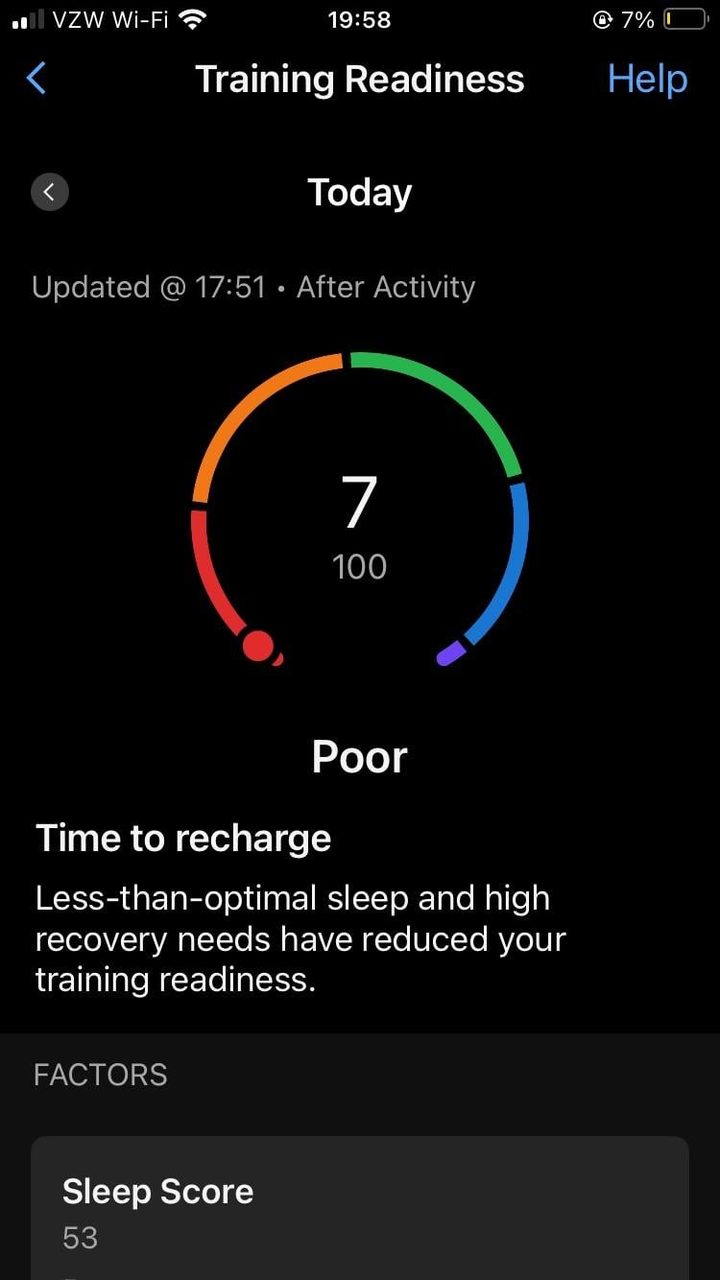
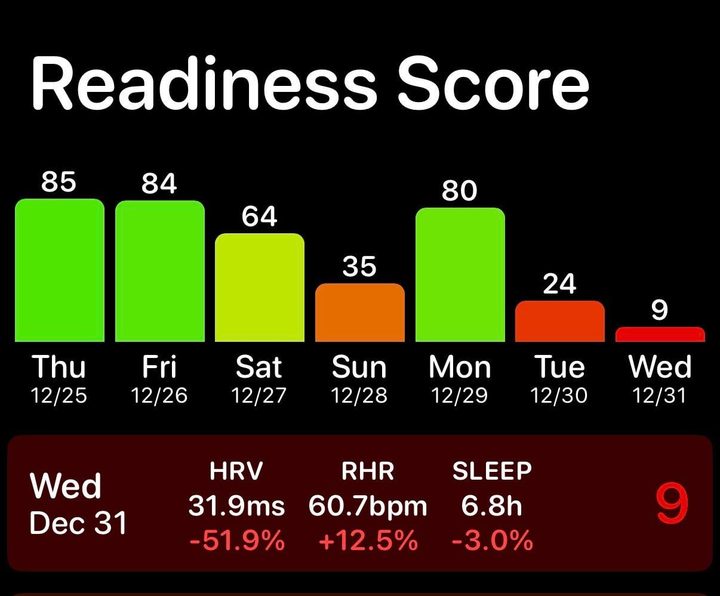
“Garmin told me to rest today”
Seven out of 100. Poor. Time to recharge. The person who posted this had slept longer than usual, their heart rate variability was in its normal range, and they felt good.
They asked the forum what to do.
An Oura ring owner, January 2025. They meant it as a good thing.
Another Oura owner, March 2025. It made them feel “confused and second guess how amazing i felt”.
January 2026. They were thinking of selling the ring.
October 2025. Every movement next to them showed up in the score.
We counted
30 posts where the score changed how someone felt. 11 where it changed their plans: a skipped run, a rest day, an early night. 8 people asking whether to believe their body or the device.
These are floors. We only counted posts our search found and we could confirm by reading.
You could say these people are just responding to real signals. Scientists have tested that, by giving people fake numbers.
Blood pressure up
Stanford gave 162 people an Apple Watch. Some saw step counts 40% lower than what they’d really walked. They felt worse, ate less healthily, had lower self-esteem, and their blood pressure and heart rate rose. Their actual steps didn’t change.
Zahrt, Crum et al., J Med Internet Res, 2023
76 vs 67
Runners got a fake recovery verdict from a “prototype” watch before a 5 km time trial. Told they were recovered, they rated their readiness 76 out of 100. Told they weren’t, 67. Their finishing times barely moved.
Carnes and Mahoney, J Hum Kinet, 2025
Sleepier
63 people with insomnia were given fake sleep scores. The ones told they’d slept badly reported more sleepiness and fatigue that day, and felt less alert.
Gavriloff et al., University of Oxford, J Sleep Res, 2018
Worse at maths
Students told they’d had below-average REM sleep did worse on a maths test than students told they’d slept well, whatever their real sleep.
Draganich and Erdal, Colorado College, 2014
So the number matters even when it’s wrong. Which would be fine, if the watches agreed on it.
Garmin Connect. Posted to r/Garmin, September 2025
Apple Health, reading the same Garmin data
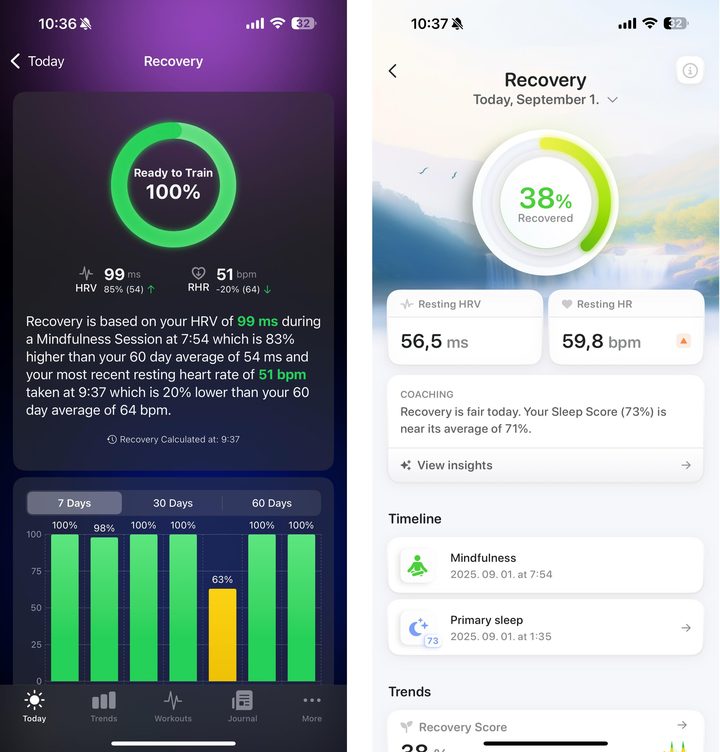
Athlytic and Bevel, one Apple Watch. Posted to r/AppleWatch, September 2025
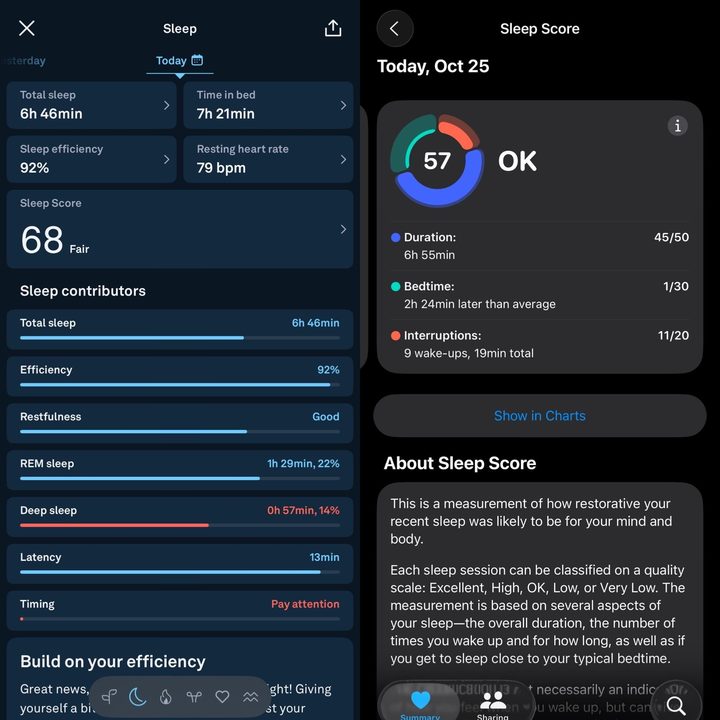
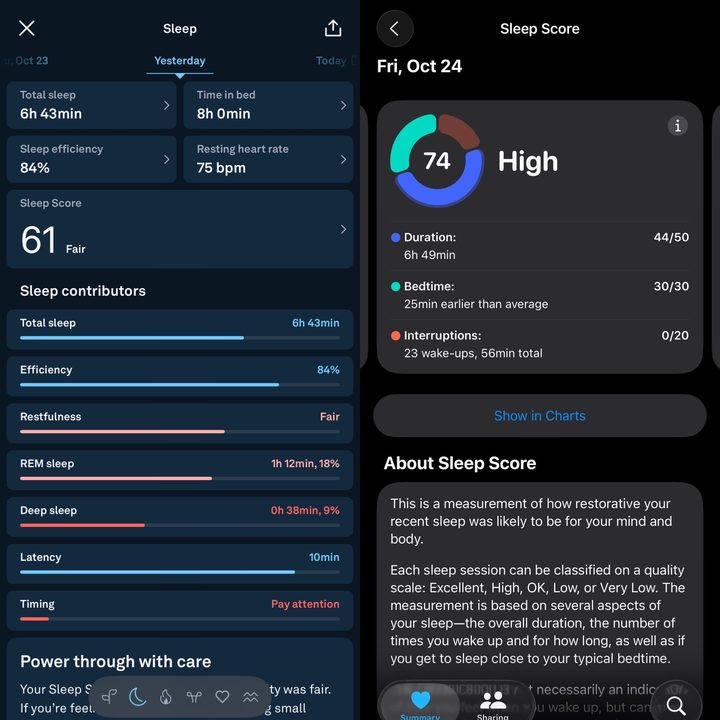
Oura (dark, left) and Apple Health (right) in each, same Oura data. Posted to r/ouraring, October 2025
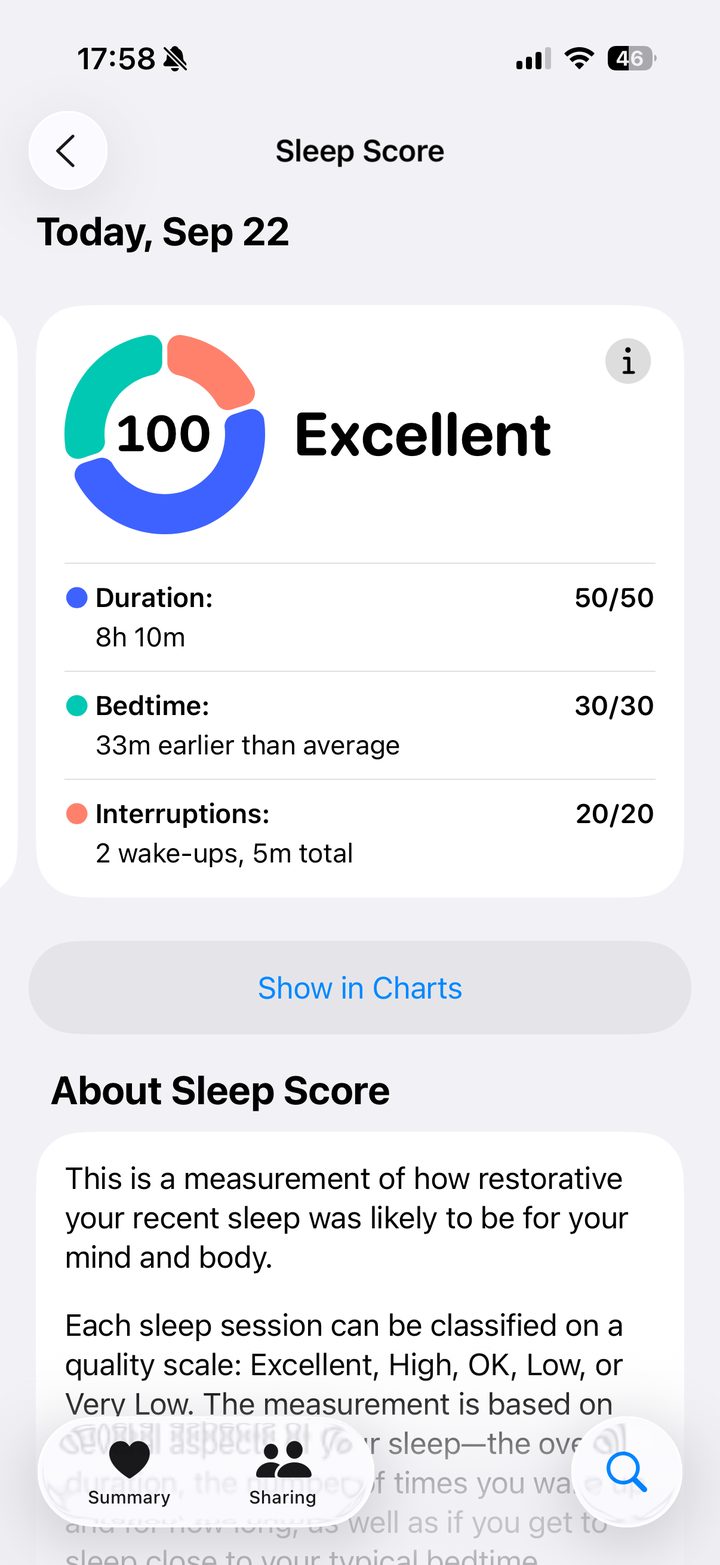
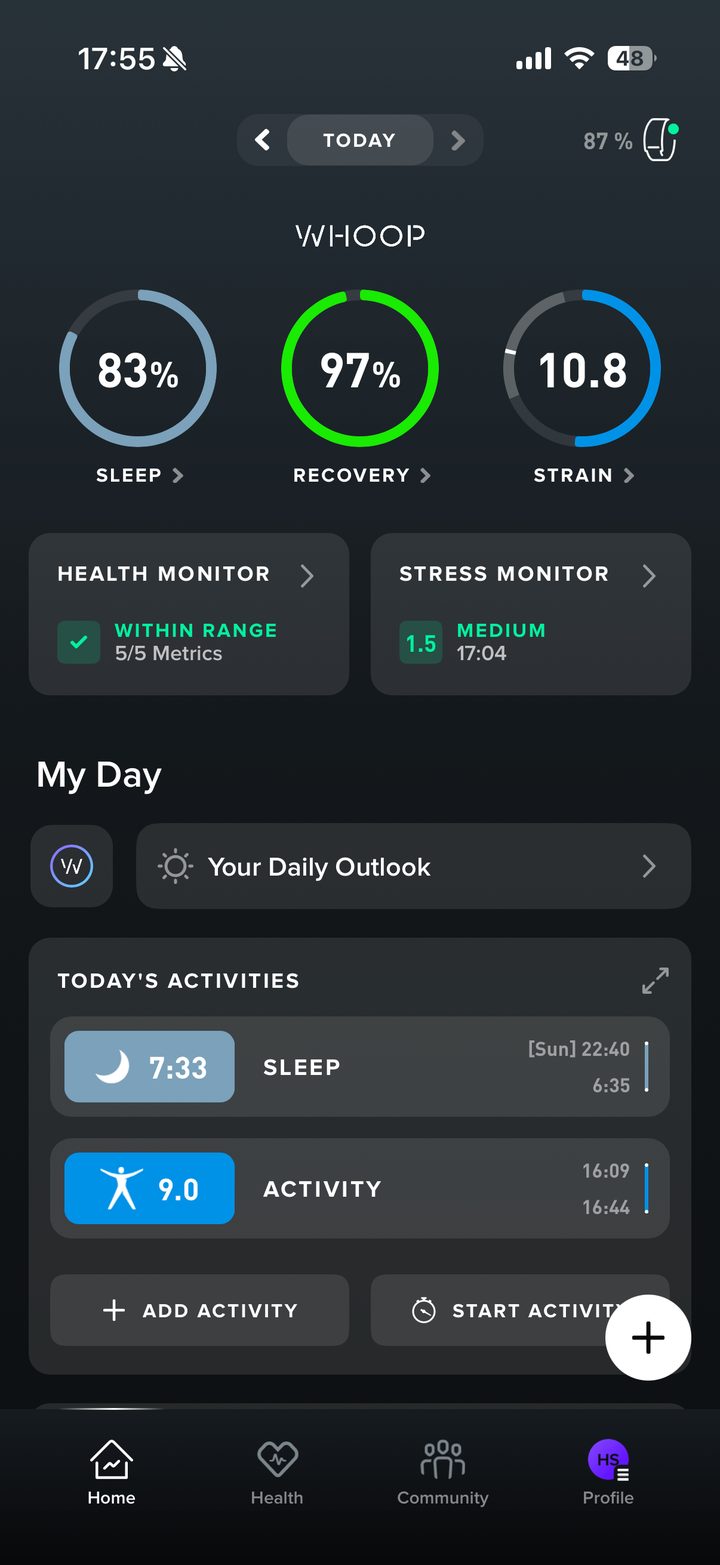
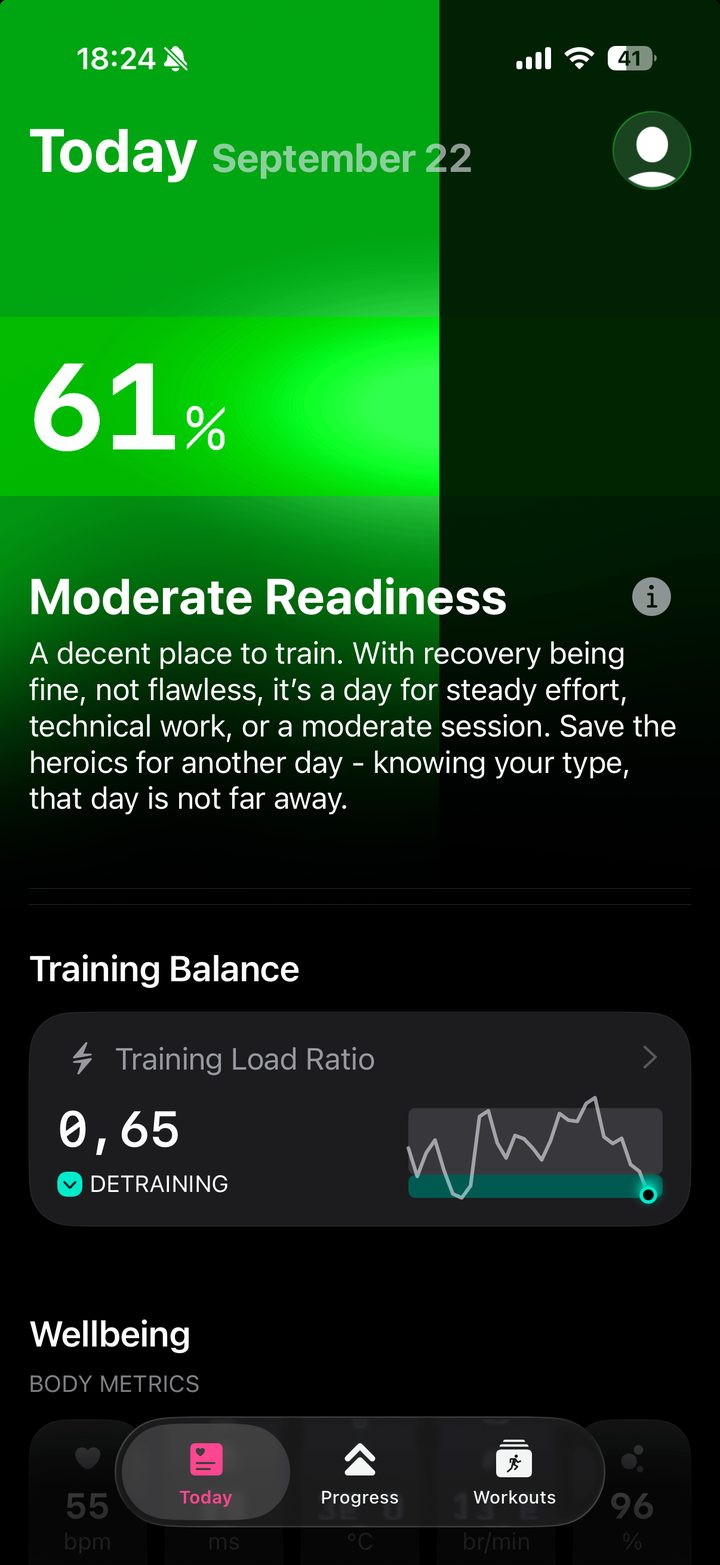
Three of the apps one person checked on 22 September 2025. Posted to r/AppleWatch
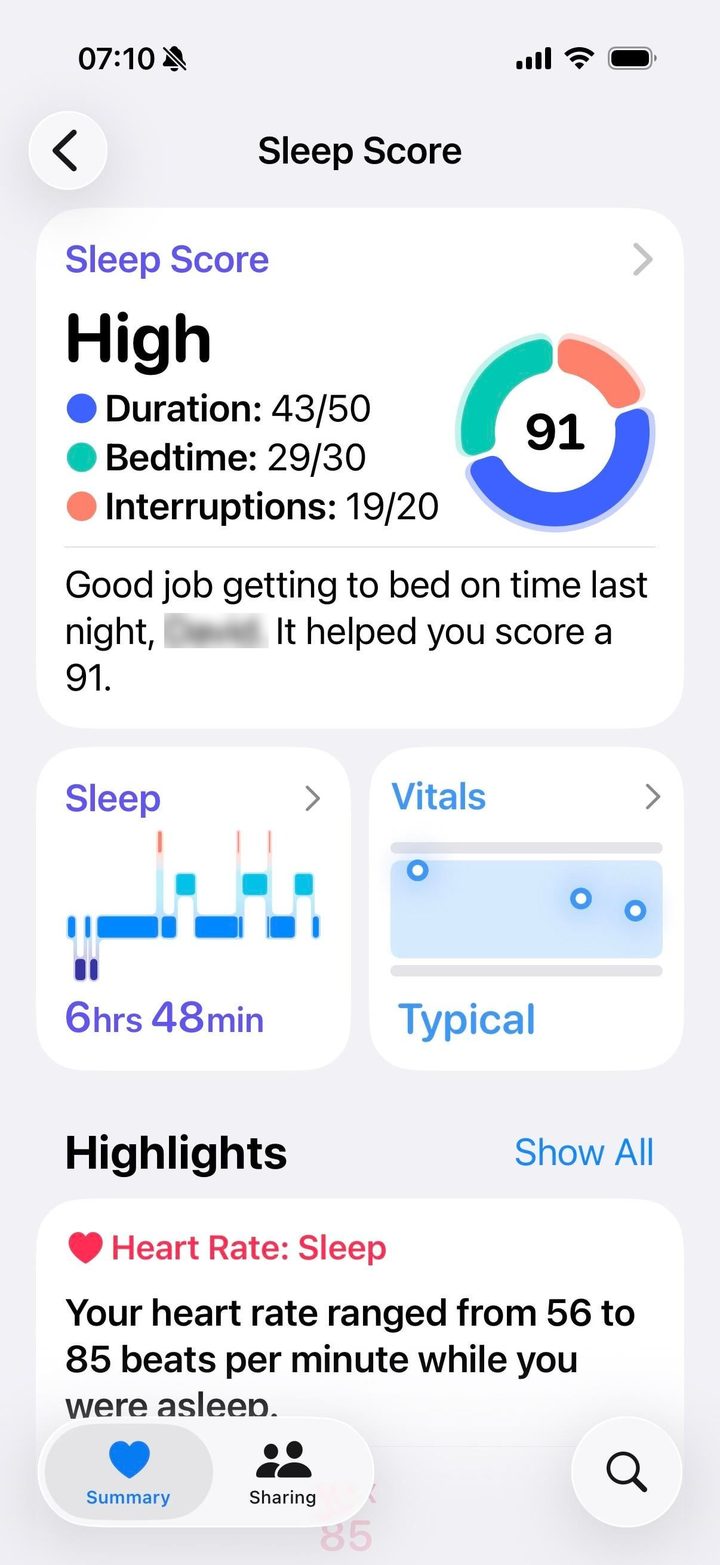
New Year’s Eve 2025, one person, two apps. Posted to r/AppleWatch
The watches agree on the hours
This is one night on a Garmin watch. 6 hours 46 minutes asleep. Garmin’s grade: 77, Fair.
Apple Health can now score sleep from other devices. So the owner let Apple read the same Garmin night.
92
6 hours 47 minutes. Excellent. “Nicely done.”
Same data, 62 points apart
Two recovery apps reading one Apple Watch on one morning. Athlytic: 100%, ready to train. Bevel: 38%.
An Oura owner who never wears their Apple Watch to bed sends the ring’s data to Apple Health. Same data, two grades, and they don’t even disagree the same way. One night Oura gives 68 and Apple 57. Another night, Oura gives 61 and Apple 74.
One morning, five apps
An app developer who pays for most of them checked them all on 22 September. Sleep: Apple 100, Athlytic 100, Bevel 88, Whoop 83. Readiness ran from 97 down to 61.
They’d have put the night at about 85.
New Year’s Eve. Apple’s sleep score: 91, High. The other app’s readiness score for the same morning:
9
Every night we found
16 nights where someone posted two or more brands’ scores for the same night, with the numbers. The typical gap between the highest and lowest score was 27 points. The six green ones came from exactly the same data.
Each row is one person’s night, from posts on r/AppleWatch, r/Garmin, r/ouraring and r/whoop between June 2025 and January 2026. People tend to post the surprising nights, so these gaps lean large. The same-data rows don’t have that problem.
The sensor recorded one night. The score is each company’s opinion of it.
Apple added a sleep score to the Apple Watch in September 2025. Posts about sleep on r/AppleWatch more than doubled that week. We read all 184 posts about the new score from its first three months. People who complained mostly said it was too generous.
Posts that judged the Apple Sleep Score as too kind or too harsh, August to November 2025. The rest were questions, bugs, bragging or neither.
“I just had a sleepscore of 98 but I absolutly dont feel like I slept a score 98.” “Excellent” after ten beers. A first-ever 100, followed by “surprisingly, I have been feeling like shit today.” In December Apple changed the labels: a score that used to be called High can now be called OK.
Some people like it this way. One Oura owner who also wears an Apple Watch explained which number they check first:
“I will always look into Apple watch sleep score first thing in the morning to get a positive boost to the mind than looking at the depressing number from Oura.”
r/ouraring, October 2025
If the number sets your mood, and different companies give you different numbers, then the watch you happened to buy is choosing what kind of morning you have.
The 10,000 people
Steps are the oldest number on the wrist. The 10,000 target comes from a Japanese pedometer sold in 1965 as the “10,000-step meter”. A 2022 analysis of 47,471 adults in The Lancet found the health benefit levels off at about 6,000 to 8,000 steps a day for people over 60, and 8,000 to 10,000 for younger adults.
We looked at 7,012 days of step data from 118 people who shared their Fitbit data for research. Most of them don’t chase 10,000. But the line shows up.
Days by final step count, in bands of 250 steps. Data: Fitabase (Furberg et al., 2016), LifeSnaps (Yfantidou et al., 2022), PMData (Thambawita et al., 2020).
Seven of the 102 people with at least 20 days of data stand out. The clearest one finished between 10,000 and 10,499 steps on 20 of their 48 days. They never once finished between 9,500 and 9,999.
One person’s 48 days. Green dots finished between 10,000 and 10,499 steps. The grey band, 9,500 to 9,999, is empty.
Sometimes it’s right
Five posts in our search were from people whose tracker caught something real. A ring flagged an infection that turned into sepsis. A watch noticed AFib within half an hour of the feature being switched on. “Garmin knew I was pregnant before I did.”
Whoop studied 30,000 new members and found their chance of drinking on a given day fell by 5.8 percentage points over their first 72 weeks. Whoop credits members seeing what alcohol does to their recovery score. It’s Whoop’s own data, not a controlled trial, but it’s a real change.
It gets things wrong the other way too. Someone on r/Garmin had flu, and their watch said they were at 100%.
The way out
A few people in these communities have taken the tracker off at night, or only check the score once a week, or stopped paying for it. One of them wrote in January 2025:
“The calm and freedom from not letting these numbers dictate my day is priceless.”
Cancel in two clicks. This page stays free either way.
How we did it
We collected every post from r/ouraring (January 2025 to May 2026), r/whoop (August 2025 to May 2026), r/Garmin (June 2025 to January 2026), r/AppleWatch (August 2025 to May 2026) and r/fitbit (March to November 2025) through the Arctic Shift archive of public Reddit posts: 95,766 posts in all. We searched them for scores changing people’s mood, plans or trust, and for posts comparing brands, then read every match and kept only the ones that clearly fit. We read all 184 posts about Apple’s Sleep Score from August to November 2025 by hand. We quote posts without usernames, and blurred a first name in one screenshot.
The same-night chart includes only posts that gave numbers for at least two brands on one night, so it is not a random sample and leans towards surprising gaps. Six nights used identical data for both scores. The step data comes from three public research datasets, 118 people and 7,012 days with at least 1,000 steps.
Zahrt OH, Crum AJ et al. Effects of Wearable Fitness Trackers and Activity Adequacy Mindsets on Affect, Behavior, and Health. J Med Internet Res 2023;25:e40529.
Carnes AJ, Mahoney SE. Are Predictive Metrics by Wearables “Unproductive”? J Hum Kinet 2025.
Gavriloff D et al. Sham sleep feedback delivered via actigraphy biases daytime symptom reports in people with insomnia. J Sleep Res 2018.
Draganich C, Erdal K. Placebo sleep affects cognitive functioning. J Exp Psychol Learn Mem Cogn 2014;40(3):857–864.
Paluch AE et al. Daily steps and all-cause mortality: a meta-analysis of 15 international cohorts. Lancet Public Health 2022;7:e219–28.
Grosicki GJ et al. Alcohol Use Trajectories During the First 72 Weeks of WHOOP Wearable Platform Membership. JMIR Mhealth Uhealth 2026;14:e91288.
Step data: Furberg R et al., Crowd-sourced Fitbit datasets (Zenodo, 2016); Yfantidou S et al., LifeSnaps (Scientific Data, 2022); Thambawita V et al., PMData (MMSys, 2020).
Screenshots were posted publicly by their owners on Reddit and are reproduced for reporting.
sheets.works is not affiliated with Apple, Garmin, Oura, Whoop, Fitbit or any other company mentioned.
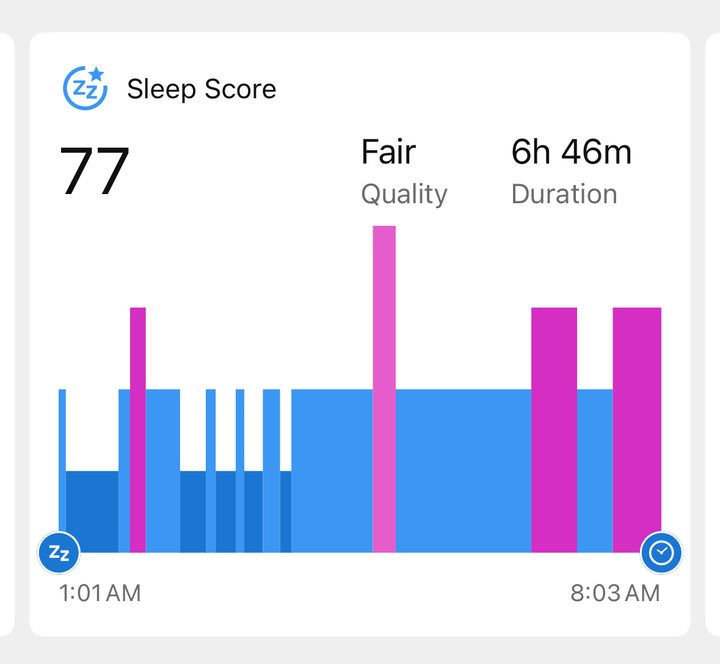 77Garmin. Fair. 6h 46m asleep.
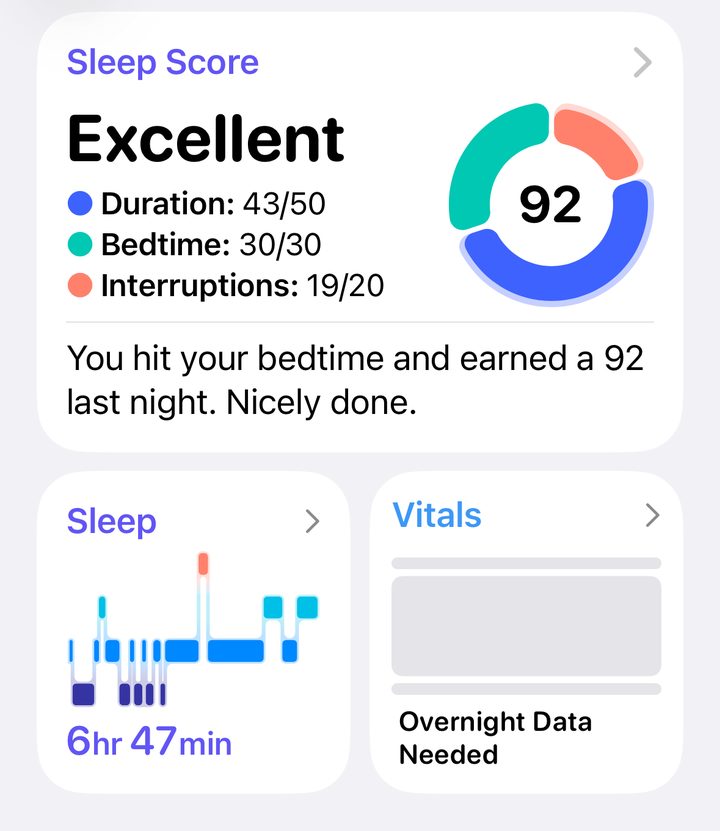 92Apple. Excellent. 6h 47m asleep.