I love illustrations, whatever they're of. From airports to food menus, a good illustration can teach you a lot. So, as usual, I wanted to learn how old this is. Since when have people drawn things to tell each other something?
An illustration is a picture made to explain something, like a story or a set of instructions. People have been making them for at least 51,000 years. Draw one here, and it will be made again the way each of them did it.
Draw over the bird, or start again and draw your own.
The oldest picture we know of that shows something happening is on Sulawesi, in Indonesia. Three figures and a wild pig, painted at least 51,200 years ago.
The paint was earth with iron in it, ground to a powder and mixed with water. Red ochre gave red, and charcoal or manganese gave black. People put it on with fingers, pads and brushes, or blew it through a hollow bone so it sprayed around a hand or a shape.
We know the age because water running down the wall left a thin mineral crust over the paint. The crust can be dated, so the painting is at least that old.
715, one monk, one book.
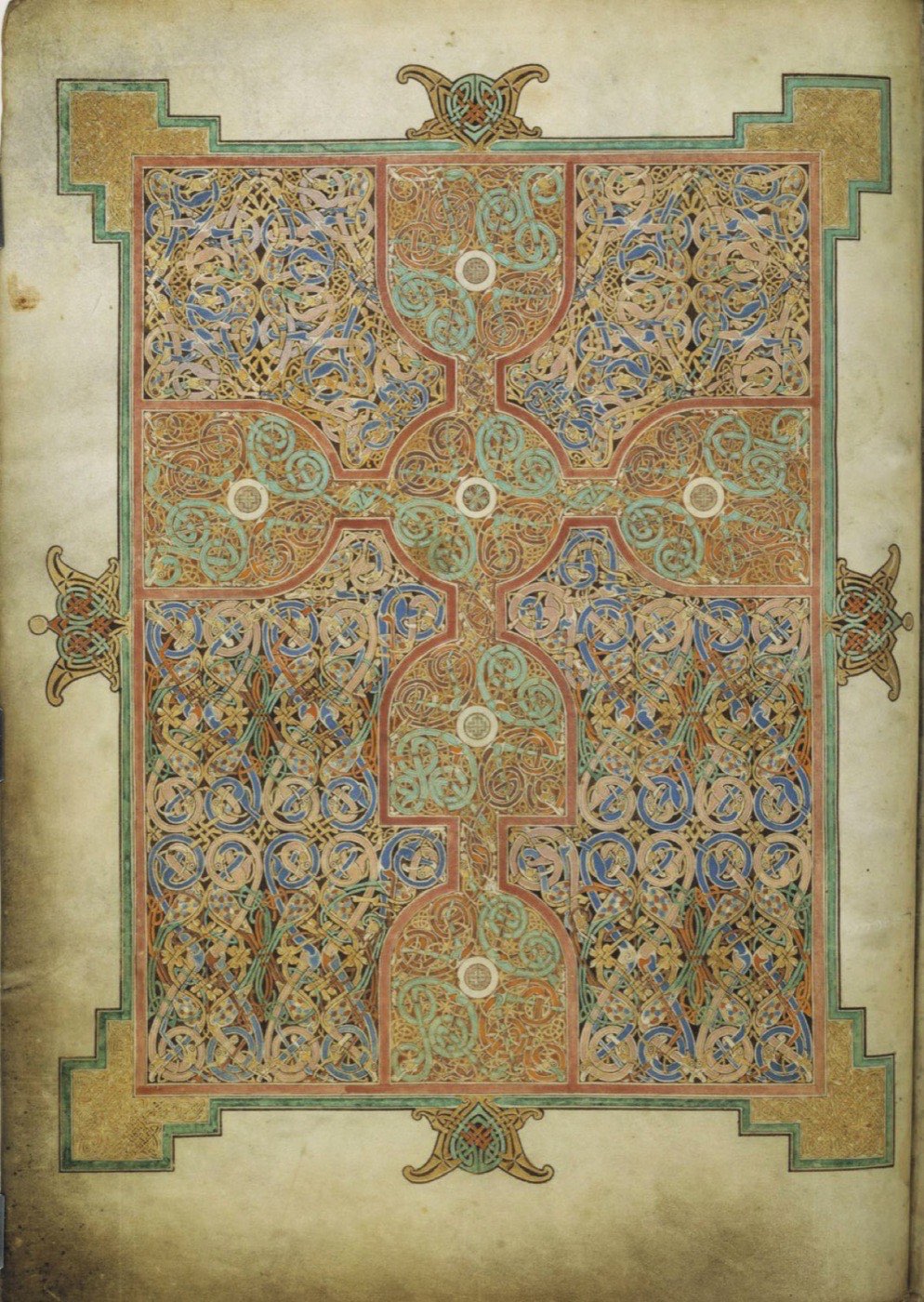
For thousands of years after that, most pictures were painted by hand into a single copy of a single book. The Lindisfarne Gospels were made on Lindisfarne, an island off the north-east coast of England. Almost all of it was written and painted by one man, Eadfrith. It took an estimated five to ten years, and he may have died before it was done.
The pages are calfskin. One calf gave about four pages, so this book needed around 130 to 150 calves. A bigger Bible made nearby at the same time needed about 515.
The colours were ground from minerals and plants. Gold leaf was laid on a sticky base and rubbed until it shone. Red came from red lead, minium in Latin. The word miniature comes from it: it first meant painting with red lead in a manuscript, and only later came to mean something small. The best blue was lapis lazuli from one valley in Afghanistan.
The carpet page before St Matthew's Gospel, Lindisfarne Gospels, about 715. British Library. Public domain.
1493, carve it once, print it thousands of times.
To print a picture you need something that can take ink again and again. The first answer was wood. Draw on a block, then cut away everything that should stay white. The lines are left standing, like a stamp. Roll ink over the block, press paper onto it, and only the raised lines print.
A woodcut in cross-section. This is relief printing.
The block prints back to front, so the drawing goes on it back to front. Wood can't hold a very fine line, so woodcuts are bold. China got there first: the oldest dated printed book in the world, the Diamond Sutra from 868, opens with a printed picture.
Once a block existed, printers used it as often as they could. The Nuremberg Chronicle of 1493 has 1,809 pictures but only 645 blocks. The same city view was printed as Damascus, Ferrara, Milan and Mantua, with only the name changed. Between about 2,100 and 2,500 copies of the book were printed. Here is your block on the real page.
Your block, printed where Damascus was.
The real page: Damascus, Nuremberg Chronicle, 1493. Public domain.
The second way works the other way round. An engraver cuts grooves into a polished copper plate with a steel tool called a burin. Ink is rubbed into the grooves and the flat surface is wiped clean. A heavy roller press then pushes damp paper into the grooves, and the paper picks up the ink.
An engraved plate in cross-section. This is intaglio printing.
Grooves in copper can be much finer and closer together than ridges of wood, so engravers could shade with rows of tiny lines. But copper is soft. A plate gave a few hundred good prints before the lines wore down. It also needs its own press, so the picture usually went on a separate page from the text.
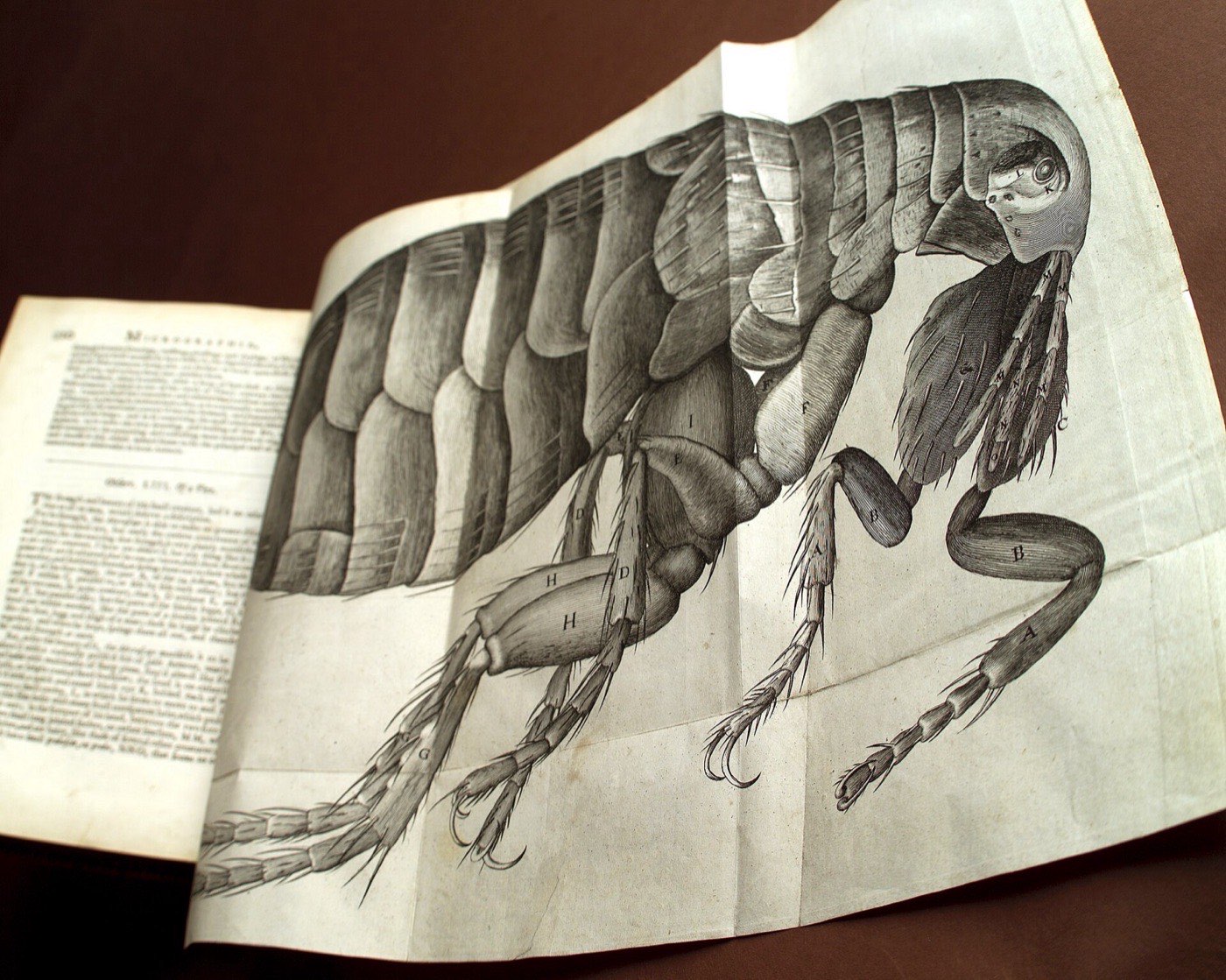
Robert Hooke drew what he saw through his microscope, and the drawings were engraved for his book Micrographia in 1665. The flea folds out to about 45 cm across. Samuel Pepys sat up until 2 a.m. with it and called it "the most ingenious book that ever I read in my life".
Hooke's flea, Micrographia, 1665. Wellcome Collection, CC BY 4.0.
1796, nothing is cut at all.
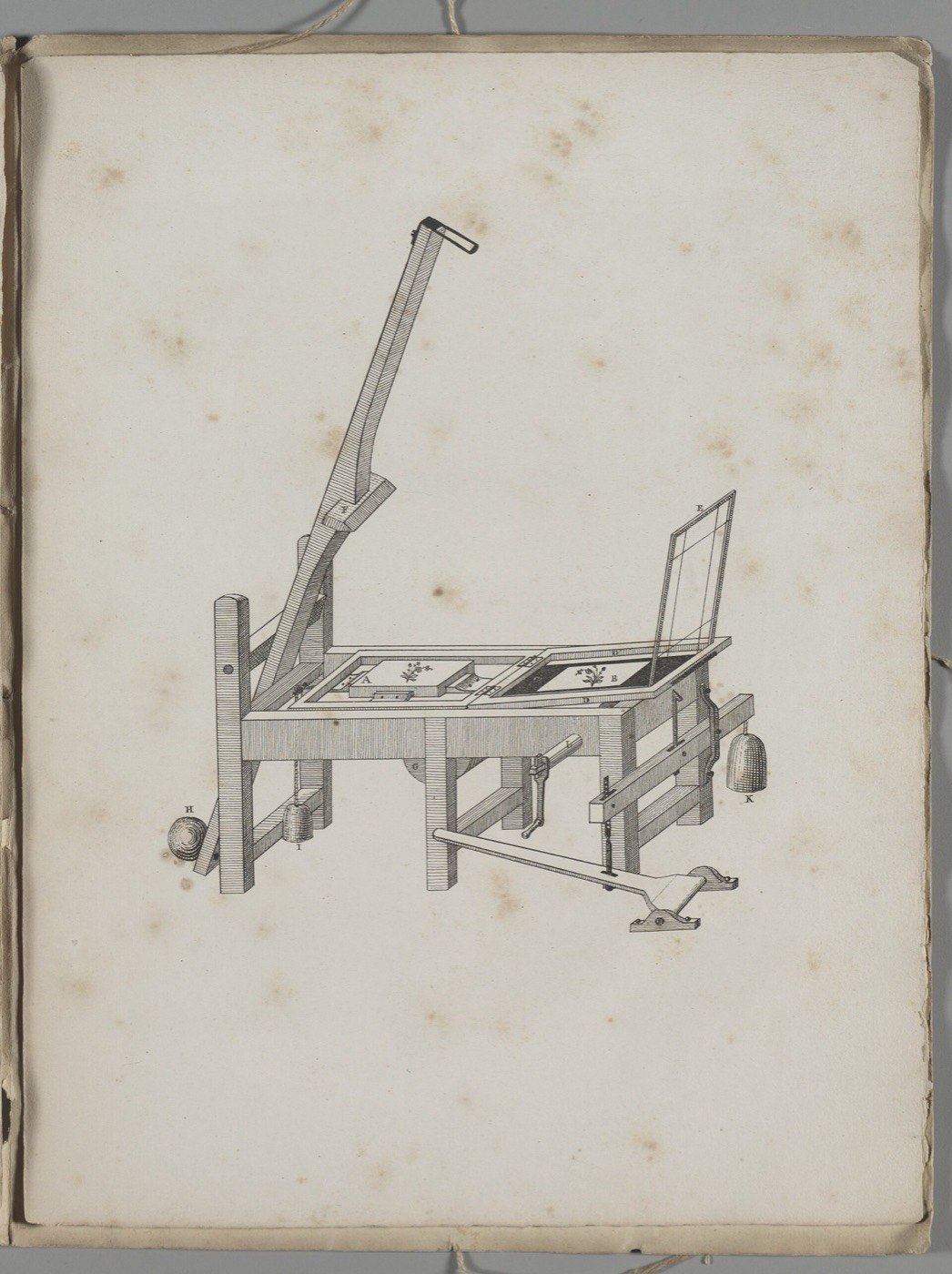
Alois Senefelder was a playwright in Munich who couldn't afford to have his plays printed. Around 1796 he found a third way. Draw on smooth limestone with a greasy crayon. Wet the stone, and the water sits everywhere except on the grease. Roll on oily ink, and it sticks to the grease and slides off the water.
A lithographic stone in cross-section. The surface is flat: this is planographic printing.
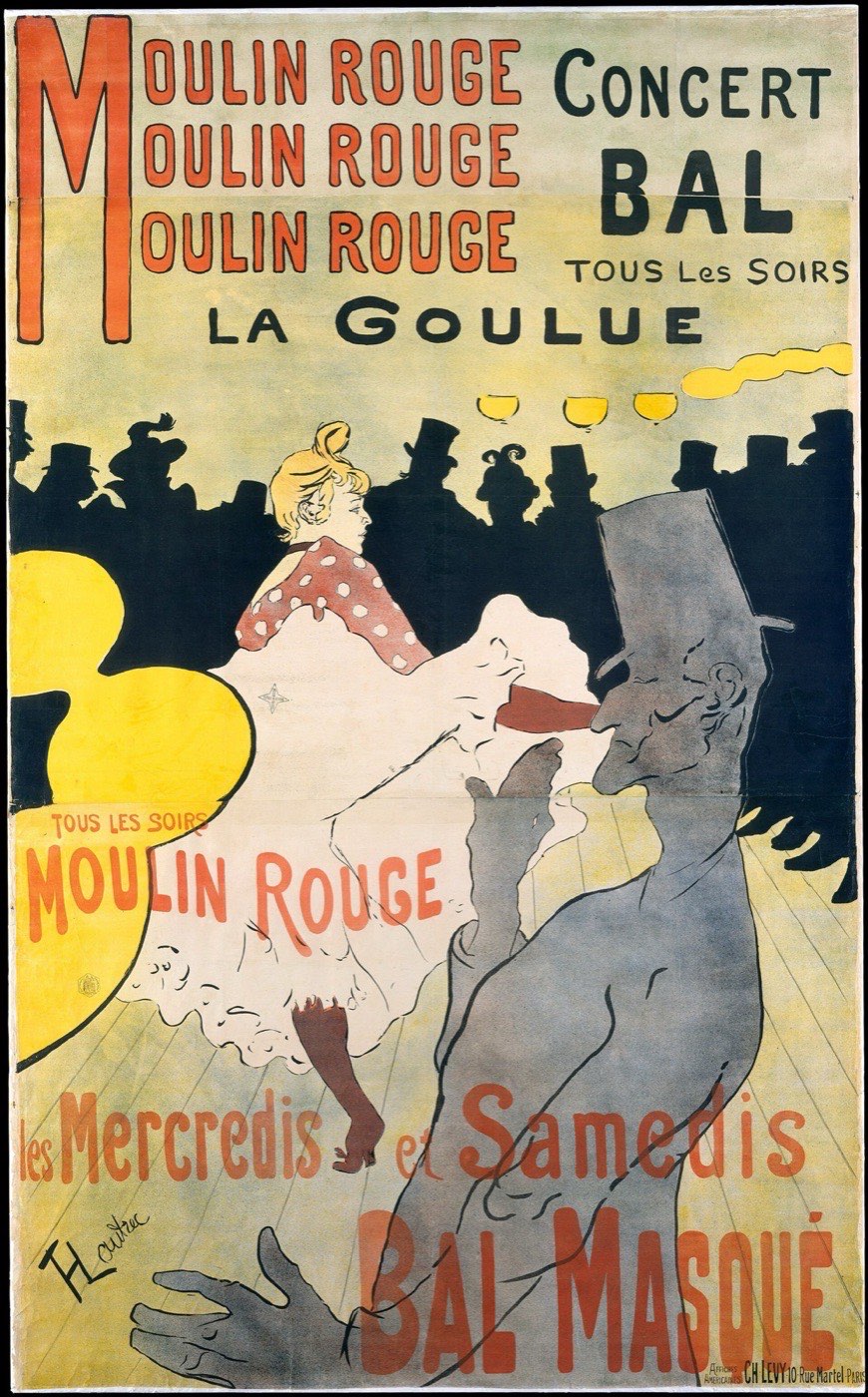
The artist could now draw straight onto the printing surface, so nobody had to copy the drawing into wood or metal. For colour, printers used one stone per colour, often 8 to 40 of them. Honoré Daumier drew news and politics this way in the 1830s. Toulouse-Lautrec drew posters in the 1890s.
Senefelder's own drawing of his press. Cleveland Museum of Art, CC0.Toulouse-Lautrec, Moulin Rouge, 1891. The Met, CC0.
1831, four people and two bowls of noodles.
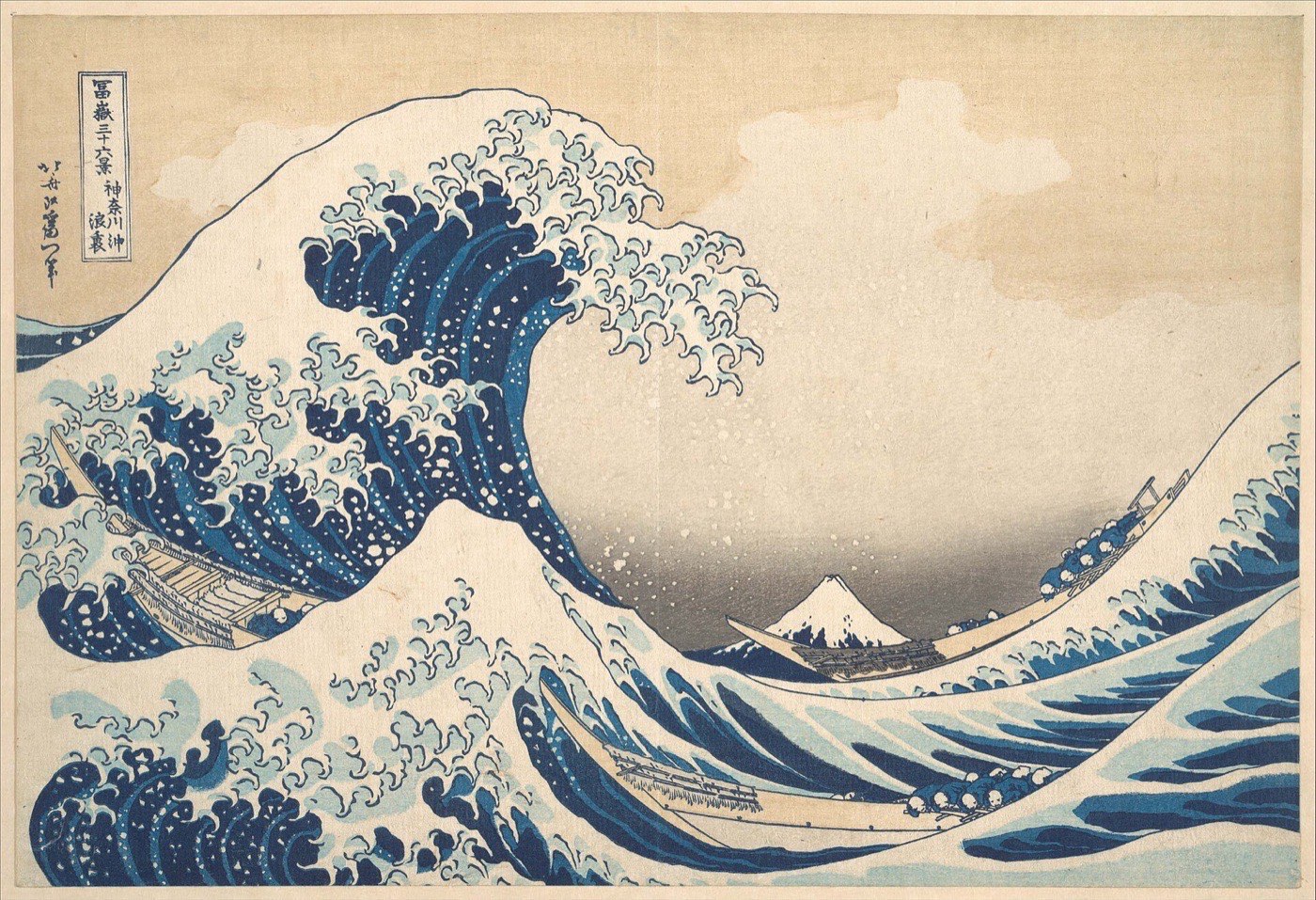
In Japan a colour print took four trades. A publisher chose the subject and paid for everything. The artist, here Hokusai, drew it in ink. A carver glued the drawing face down onto cherry wood and cut through it, which destroyed the drawing. Then he cut one more block for every colour.
A printer brushed colour onto each block and rubbed the paper on by hand, one block at a time. A notch cut into the corner of every block kept the colours lined up.
The Great Wave blocks printed up to about 8,000 copies before they wore out. Each sold for about 16 mon, the price of two bowls of noodles. In 2023 one sold for $2.76 million.
Hokusai, Under the Wave off Kanagawa, about 1831. The Met, CC0.
Newspapers wanted pictures, but copper couldn't print next to words and ordinary woodcuts were too coarse. Thomas Bewick found the answer in the 1790s. He cut into the end grain of boxwood, which is hard enough for fine lines and can be locked into the same press as the type. One of his blocks printed more than 300,000 copies.
The Illustrated London News launched in 1842 with pictures on its pages every week. It sold 26,000 copies of its first issue and over 300,000 a week by 1863. Boxwood trunks are narrow, so a big picture was drawn across small blocks bolted together. The blocks were unbolted, handed to different engravers, and bolted back. At the end of 1842, Ebenezer Landells and 18 assistants cut one view of London on 60 blocks, working "day and night for two months". It was given away with the paper on 7 January 1843.
Tap a block in the last picture to see who cut it.
1880, a machine takes the engravers' job.
Every picture so far was copied by hand into wood, metal or stone. Halftone did the copying with a camera. A photograph is taken through a fine grid that breaks the picture into dots: big dots where it is dark, small dots where it is light. Acid etches the dots into a metal plate that prints alongside the type. From a normal distance your eye blends the dots back into greys.
The first halftone in a newspaper ran in New York on 4 March 1880. By about 1900 dots had almost completely replaced hand engraving in magazines and adverts. Nobody has counted how many engravers lost their work. One of them, Clemence Housman, was owed £100 in wages when her firm closed.
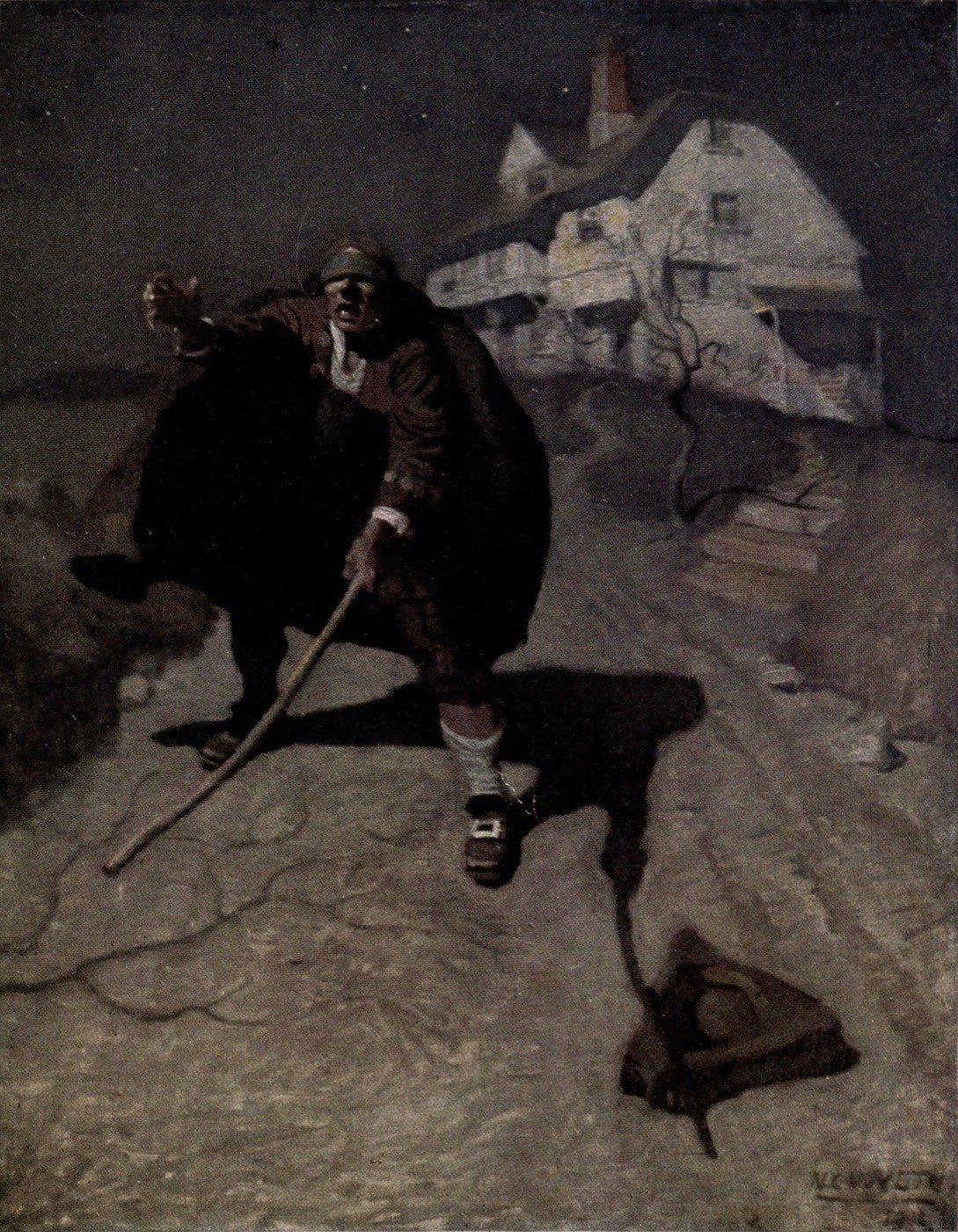
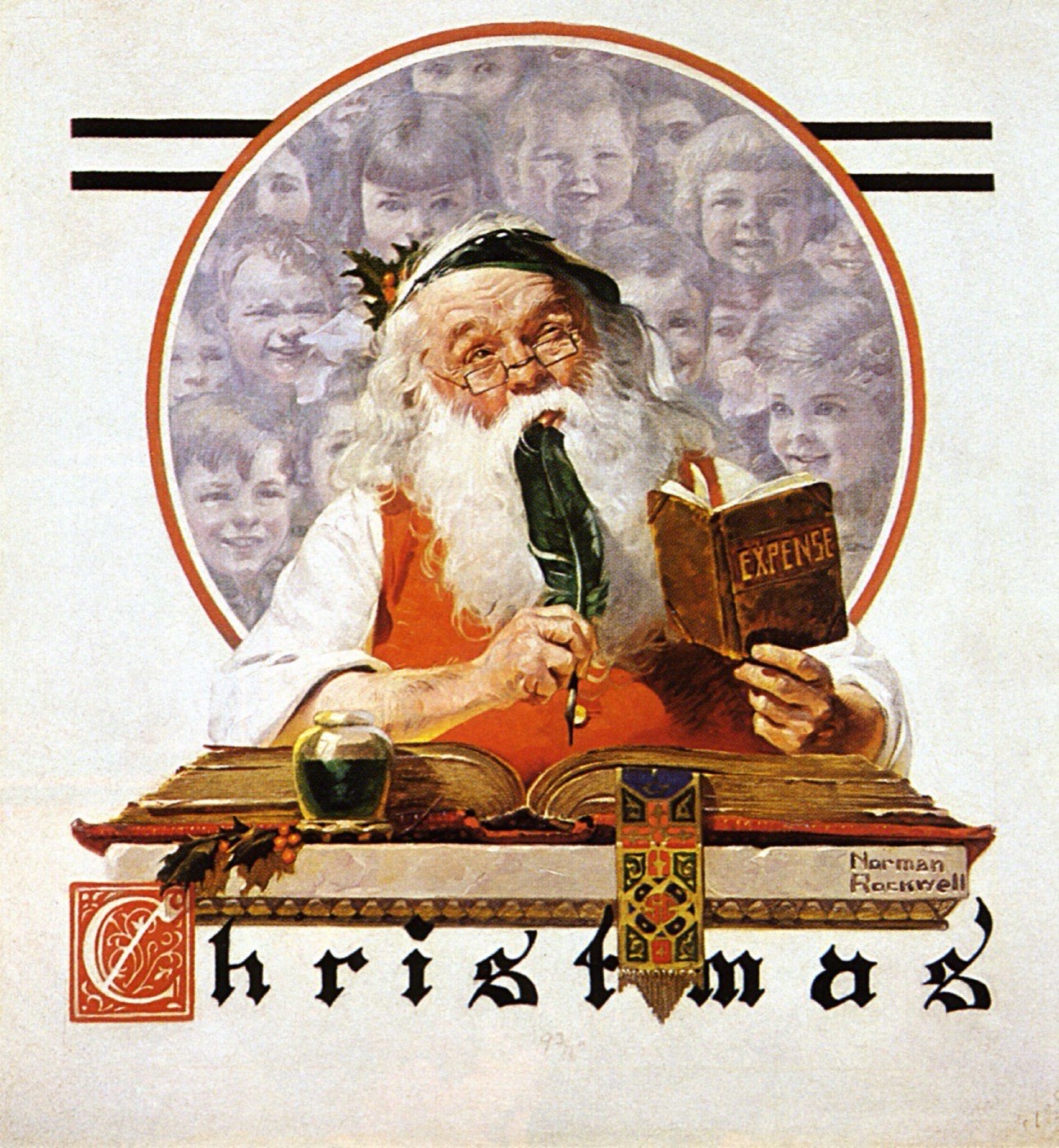
Halftone could print an artist's painting as it was painted, with nobody copying it in between. Magazines paid well for that. Scribner's paid N.C. Wyeth $2,500 for 17 Treasure Island paintings in 1911. The Saturday Evening Post paid Norman Rockwell $75 for his first cover in 1916 and sold about 2 million copies a week.
In 2013 one of his later Post covers, Saying Grace, sold at Sotheby's for $46 million.
N.C. Wyeth, Blind Pew, Treasure Island, 1911. Public domain.Norman Rockwell, Saturday Evening Post cover, 1920. Public domain.
1963, a drawing made of numbers.
At MIT, Ivan Sutherland wrote a program called Sketchpad and drew on a computer screen with a light pen. The computer didn't keep a picture of each line. It kept the two end points of the line as numbers, so a drawing could be moved, copied, resized and changed without being drawn again.
Vector drawing programs, like Adobe Illustrator from 1987, still store lines this way. Pen tablets, Photoshop in 1990 and the iPad brought drawing onto screens for everyone.
How many people could see one picture.
Cave wall, 51,200 years ago1 copy
Lindisfarne, 7151 copy
Nuremberg Chronicle, 1493~2,100 to 2,500
One copper plate, 1600sa few hundred
The Great Wave, 1831~8,000
Illustrated London News, 184226,000
One Bewick block300,000+
Saturday Evening Post, 1913~2 million
Peanuts, 1999355 million a day
Copies or readers of one picture, on a log scale: each step to the right is about ten times more. Peanuts ran in 2,600 papers, drawn by one man, Charles Schulz.
2025, pictures nobody drew.
In the first week of ChatGPT's image tool in March 2025, 130 million people made 700 million pictures. That is about 1,150 a second.
You spent about 20 seconds on yours. In that time, about 23,000 pictures were made that nobody drew.
In October 2026, 46% of illustrators in a UK survey said they had lost work to AI, up from 32% a year before.
Keep yours.
Tap any of them to save it.
Get the next one.
One story like this a week, by email. You can leave any time.