data drops / why boarding takes forever
Why boarding takes forever
In 2008 an astrophysicist worked out the fastest way to board a plane. Almost no airline uses it. This is that story, told from seat 8D.
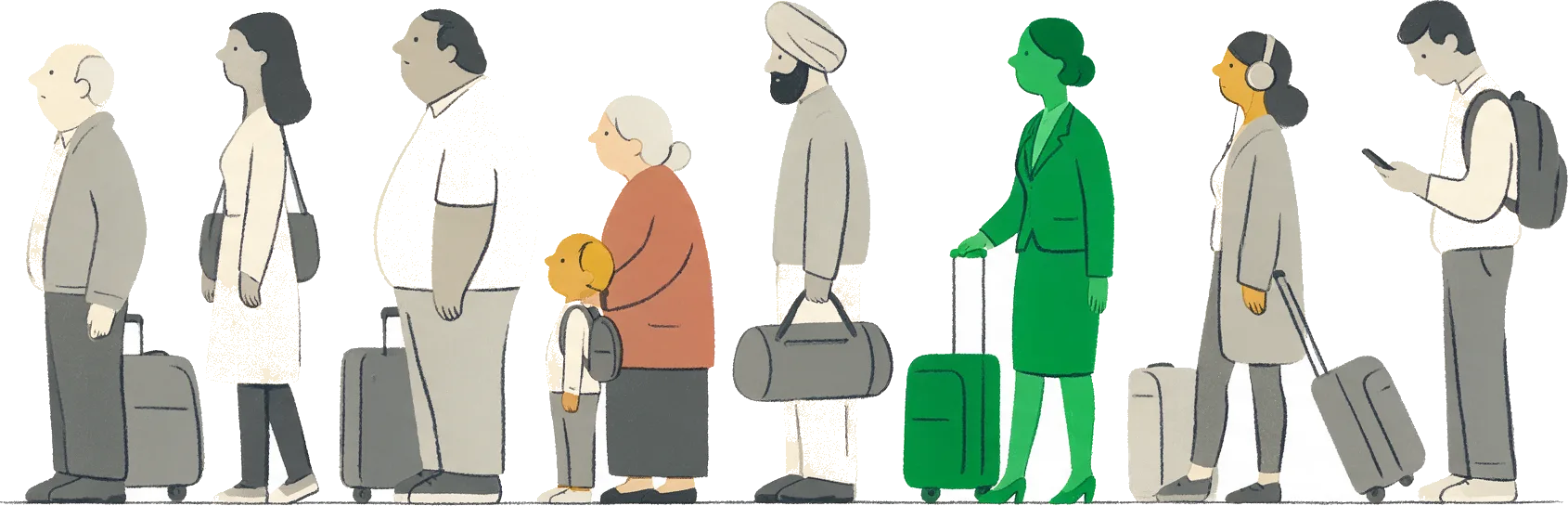
a single-file queue of airline passengers, one dressed in green
Last flight, I had seat 8D. Row 8. Practically the front of the plane.
From the aircraft door to my seat took almost twelve minutes. People in the aisle. Kids in the aisle. Bags going up, one at a time, while everyone behind them stood and watched.
Twelve minutes. Row 8.
a passenger waiting, shoulders slumped
You know the moment too. Boarding begins, and forty people who are not in group 1 stand up anyway and drift toward the rope. You stay seated, like a reasonable person. By the time your group is called, the bins above your row are full.
Our parents boarded twice as fast as we do.
1970s · about 20 people a minute
today · about 9
passengers boarded per minute, US domestic · Boeing measurements, via The New York Times, 2011
Planes got fuller. Bag fees pushed every suitcase into the cabin. Boarding groups added a queue on top of the queue. So boarding got slower, year after year. Which leaves one question: what is the fastest way to put people on a plane?
One man rented a fake airplane to find out.
In 2011, on a film soundstage in Southern California, Jason Steffen, an astrophysicist who normally hunts exoplanets, rented a mock Boeing 757 cabin: 12 rows, 72 seats, one aisle, working bins. He hired 72 passengers from age five up, gave each a roller bag, and printed numbered boarding cards.
Five takes. Same people, same bags. Only the order changes. You are passenger 30, seat 8D. Keep your card.
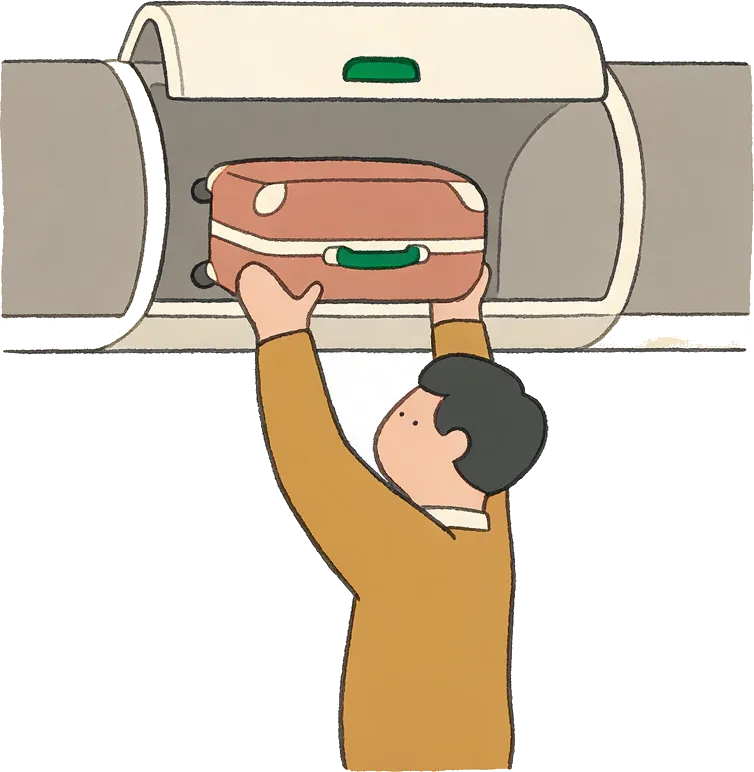
a passenger lifting a bag into an overhead bin

The aisle is a computer

Forget the plane for a minute. Boarding is a scheduling problem. There is one narrow lane. Only one person can use each bit of it at a time. And 72 jobs each need the lane for a moment, then leave it forever by sitting down. Programmers meet this shape every day: one disk head, one lock that every thread wants, one checkout counter.

In 2006 the mathematician Eitan Bachmat worked out what boarding time actually is. It is the length of the longest waiting chain. You wait for the man ahead of you, he waits for the woman stowing her bag, she waited for someone else before that. The plane is boarded when the longest such chain has finished. Nothing else matters. (He proved it by mapping the cabin onto the geometry of spacetime, the same math as relativity, which is its own kind of joke about air travel.)

The three pictures show the three shapes a chain can take. Back-to-front links all 72 people into one long chain, so everything happens one at a time. A random order does much better, and the reason is lovely: when you shuffle people, the longest run of them that happen to block each other is only about 2√N people long. Mathematicians proved that in 1977. For 72 passengers it means a chain of about 17, and that is the whole reason chaos beats the airlines. Steffen's order goes further. It is built so people standing next to each other in the queue never need the same bit of plane, so chains barely form at all.

# Steffen (2008): consecutive passengers sit two rows apart, # so their bags never compete for the same bin or aisle space for seats in [windows, middles, aisles]: for side in [left, right]: for parity in [odd_rows, even_rows]: for row from back to front, step 2: board(passenger[row, side, seats])

This trick already runs the world. Just not at the gate.

The disk in your laptop schedules reads this way. Bachmat proved the boarding math and the disk math are the same.
RAID storage in every data centre stripes writes across disks so no single disk becomes the queue.
The memory serving this page interleaves its banks so back-to-back reads never hit the same one. Steffen's order is bank interleaving for people.

Your airline's queue and your hard drive's queue are the same queue. One of them has been optimised since the 1970s.

sources: Bachmat, Berend, Sapir, Skiena & Stolyarov, J. Phys. A 39 L453, 2006 (physics/0512020) · the 2√N law: Vershik & Kerov, 1977 · Steffen, J. Air Transp. Manag., 2008 (arXiv:0802.0733)

Five takes, one stopwatch. The measured order:

boarding times for 72 passengers, mock 757, measured 2011 · icons show each boarding order, light seats board first · source: Steffen & Hotchkiss, J. Air Transp. Manag. 2012, arXiv:1108.5211

The order airlines believe in came fourth. The order most of them actually run came last. The difference is bags: Steffen's order keeps 2.0 going into bins at the same moment, block boarding manages 1.3.

And the order decides your evening. Seat 8D stands still for 0:11 under Steffen, 1:13 boarding back-to-front, and in block groups it sits down at 4:32, after the whole plane would have finished in take 4.
The airlines already know.
This is not a secret they missed. America West helped write one of the research papers itself, in 2005. United measured windows-first with its own operations team, switched economy to it in October 2023, and said it saves up to two minutes a flight.
So why does your boarding still feel like take one? The first reason is honest: families. Every clean order splits them, and nobody wants a six-year-old boarding twelve people after her mother.
an airline officer reading a research paper
The second reason is money. In 2008 airlines started charging for checked bags, so suitcases moved into the cabin and boarding slowed further. Then airlines began selling the escape: priority boarding, early groups, a better queue for a fee.
The queue became a product. And the product sells because the queue exists.
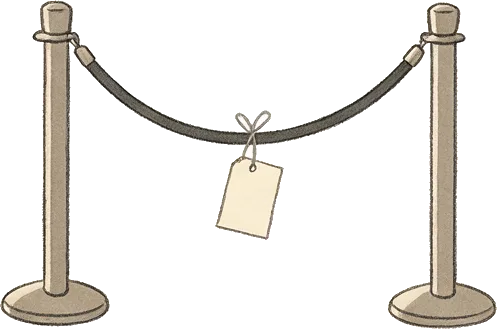
an airport queue rope with a price tag hanging from it
The queue costs the airlines too. A plane parked at a gate burns 30 to 250 dollars a minute, and they keep the queue anyway.
When Southwest ended open seating in January 2026 to sell assigned seats, NPR's headline said it plainly: profit over speed.
sources: van den Briel et al., Interfaces, 2005 · NYT, 2011 · AP, 2023 · NPR, 2024 · Southwest press release, jan 2026 · USA Today, 2026
the nose of a plane parked at a jet bridge

Who flies which order, today

United: AP, october 2023 · Delta zones and American groups: airline boarding pages, 2026 · Southwest: press release, january 2026 · the empty last row is the point of this story
The physics has been public since 2008.
The experiment has been public since 2011.
Your airline has read both.
Ask why boarding still takes forever.

More data drops

If you hate waiting, raise your hand
ten cities, ten cabs, 380 years · the fleet you can summon with one hand
The button next to undo
68,948 thank-yous between Wikipedia strangers, in one month
All the drops
the full shelf, free

Like this kind of story?

Drop your email. The next one lands free. Nothing on this page is locked.

by Akash Wadhwani · sheets.works · august 2026
simulation calibrated to the 2011 experiment · ranking reproduced 5 of 5, times within 9% for four methods, our random runs 23% slow and we say so
cabin dimensions from the paper: rows 32 in, aisle 21 in