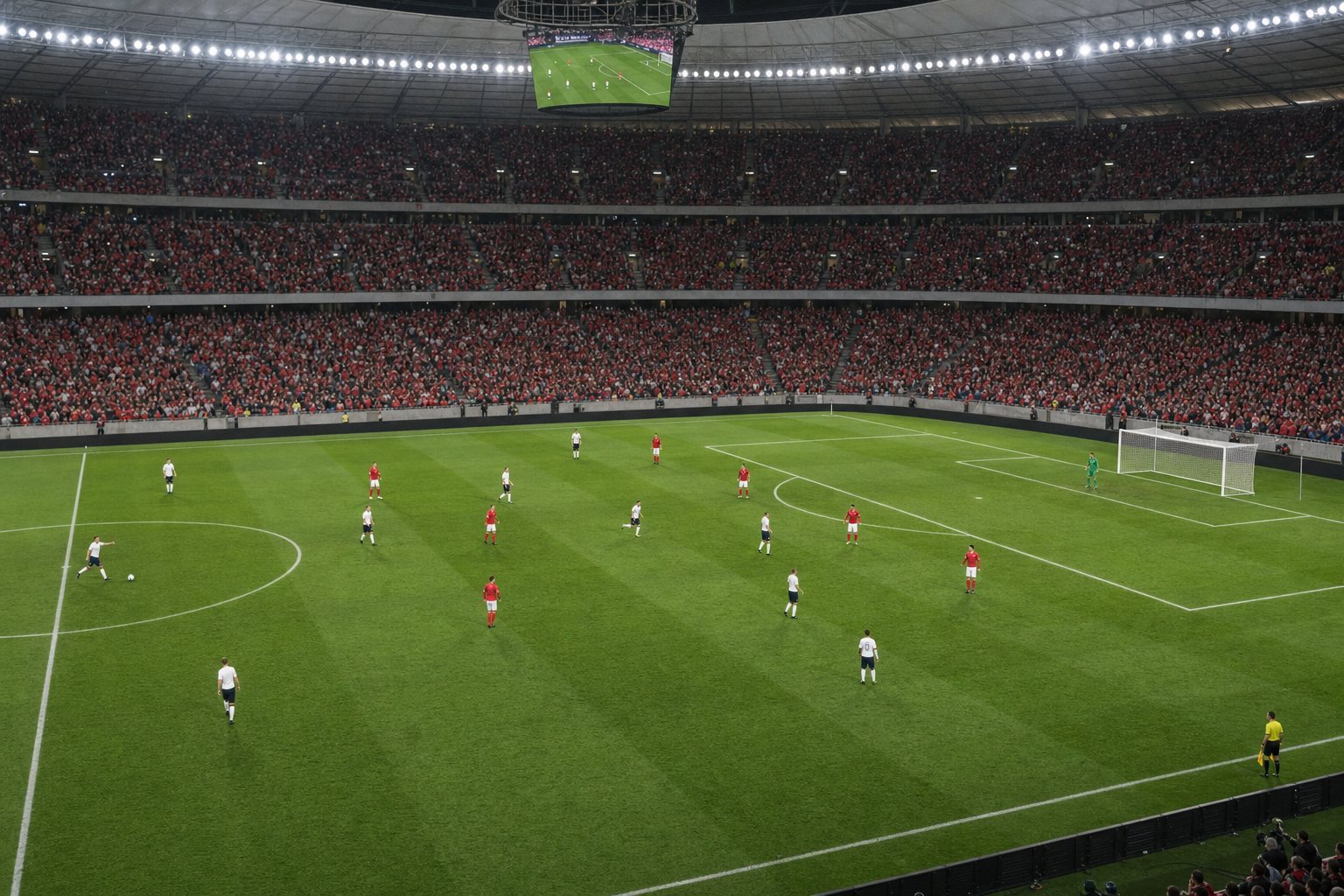
We invented the goal. The systems and the delays are real, and the sources are at the bottom of the page.
The stadium is a roofed World Cup ground in Los Angeles with 70,000 people in it. The photos are AI-generated from a 3D model we built, and the tracking view is drawn straight from that model.
The ball finds out first. There's a motion sensor inside the 2026 World Cup ball, and it takes a reading 500 times a second, so once every 2 thousandths of a second.
When someone kicks it, the reading jumps. On the VAR's screen the trace looks a bit like a heartbeat.
FIFA; adidas
The sensor sits in one of the ball's four panels. The other three have small weights in them so the ball still flies straight. It gets charged on a dock before kick-off.
It has been used to settle an argument before. Against Uruguay in 2022, Cristiano Ronaldo celebrated a goal as his. adidas said the sensor picked up no touch from his head, so the goal was given to Bruno Fernandes.
Panel layout: press reports, no adidas spec sheet. Ronaldo: adidas statement, 29 Nov 2022
The ball also sends out its position by radio, and a ring of antennas around the pitch picks it up. The signal crosses the pitch in under a millionth of a second.
The company that makes the tracking says it can place the ball to within about 10 cm.
KINEXON, the ball's tracking partner (maker's figure)
There are 16 cameras under the roof, filming every player 50 times a second. Software finds 29 points on each body, like the head, shoulders, elbows, knees and feet.
So the system has 22 skeletons, updated every 20 thousandths of a second. FIFA says it collects more than 150 million data points in one match.
FIFA, World Cup 2026 technology notes
Offside is judged at the moment of the pass, which was 1.4 seconds before the shot. The cameras can't pin that moment down on their own. In one 20 ms frame, a striker running forward and a defender stepping up can move 28 cm further apart.
So the system uses the spike from the ball to pick the right frame. Then it draws the line through whichever bit of the defender is closest to his own goal. In our goal the striker is onside, by a few centimetres.
FIFA; 28 cm is our arithmetic (9 m/s + 5 m/s over 0.02 s)
The assistant referee has an earpiece. Since 2026 it beeps by itself when the system spots a clear offside, before any person has looked at it. This time there's no beep, so he keeps his flag down.
FIFA, 2026
The ball goes over the line, and everyone in the stadium sees it at once. The noise is slower: sound takes about a third of a second to get from the goal to the back of the top tier.
Up in the stands, a man with two phones taps a button marked goal.
Ball flight: 20 m at 100 km/h. Sound: 343 m/s over about 120 m. Both our arithmetic.
He's a data scout. One phone films the match and the other logs what happens, and that log goes straight to betting data companies. Within a second of his tap, bookmakers stop taking bets on the match.
A scout who covers matches in Guwahati told The Ken he gets ₹4,500 to ₹6,500 a match. If he logs a goal late, he might not get paid for it.
The Ken (scout pay); Sportradar developer docs ("bet stop")
Out in the car park are the TV trucks. A World Cup match has around 45 cameras on it, and their pictures leave the stadium on fibre along with the tracking data.
Host Broadcast Services via RedShark News, 2026
All of it goes to one building in Dallas, about 2,000 km away. Light in glass fibre travels about 200 km in a thousandth of a second, so the trip takes at least 10 thousandths.
Network figures: Verizon carried about 7 terabits a second from 16 stadiums to Dallas (RedShark News)
The VAR isn't at the stadium. At the 2026 World Cup, video review for every match was done from the broadcast centre in Dallas.
The officials there check the moment of the pass and the line, then talk to the referee through his earpiece. FIFA says this takes a few seconds.
RedShark News; FIFA
By then the scout's tap had already crossed the Atlantic. Betting data companies sell their feeds to bookmakers in London and plenty of other places, and they say the data gets there in under a second. So the bookmakers had stopped taking bets a few seconds before the VAR was done.
Genius Sports (its own claim)
Next is TV. At the Super Bowl in February, Stats Perform had people in the stadium timing the broadcasts. Over-the-air TV was about 19 seconds behind the pitch, and cable was about 38.
Every step adds a bit. The director picks a shot, then the picture gets compressed, sent to a network and compressed again.
Stats Perform, Super Bowl LX, Feb 2026
Say you're watching on your phone in New York. The stream leaves Dallas on the same fibre as the betting data and comes off at the coast, about 2,300 km later. The betting data kept going under the Atlantic for another 5,800 km and still reached London at 1.6 seconds.
Light gets through 2,300 km of fibre in about 12 thousandths of a second. So the distance adds almost nothing to your wait.
Route drawn by us along US fibre corridors, one likely path, not a traced one. Distances and light time are our arithmetic (light in fibre: about 200 km per millisecond).
A live stream is sent as a string of short chunks, and Apple recommends 6 seconds each. Your phone won't start playing closer than three chunks to the newest one, which is 18 seconds of delay before anything else happens.
Then add the time to encode the video, get it to a server near you and fill your app's buffer. At the Super Bowl, streams were 48 to 62 seconds behind.
Apple HLS authoring spec; RFC 8216, section 6.3.3; Stats Perform
Now you see the goal. The ball, the roof cameras, the scout, the bookmakers, the VAR and anyone watching on TV all knew before you did.
If a friend at the match texted you, that beat the stream too. A text is a few small packets, and it comes down the same fibre in well under a second.