Staff at a Warrnambool aged care home had never heard Noeleen speak, and then she did
A stroke took Noeleen's speech and left her with vascular dementia, so by the time she was living at an aged care home in Warrnambool there were staff at the home who had never heard her say a word. A touchscreen built for people with dementia changed that, and the same home used virtual reality goggles to put her and her husband back in Dublin, where the two of them once went on holiday, for about fifteen minutes.
22 September 2026
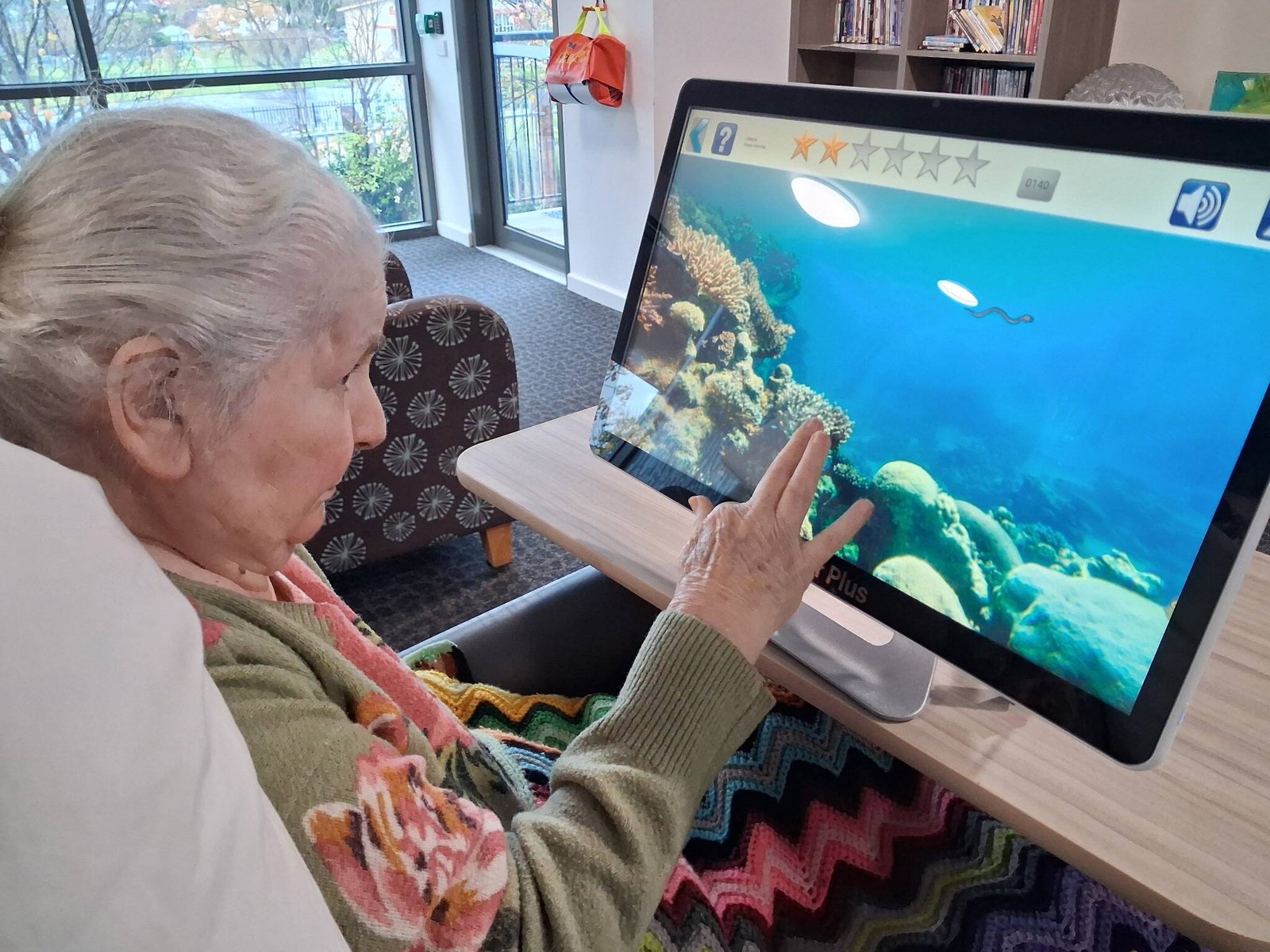
Noeleen was a market researcher who ran her own business until a stroke took her speech, and what followed was vascular dementia, in which thinking and reasoning and memory go because blood is not reaching the brain properly, so that by the time she was living at Mercy Place in Warrnambool there were staff there who had never once heard her say anything at all.
Bev Stutchbury, the home's lifestyle coordinator, has watched that change over the past few months, and the way she puts it is that "some of us had not heard her speak and then suddenly she's saying words," which she called heartwarming in itself.
A screen you touch
What changed was a piece of equipment called Brain Trainer Plus, a large touchscreen loaded with games and pictures, one of several pieces of equipment the home has taken on in the last three to six months. Her husband Peter says it makes her focus, gets her thinking, gives her something to enjoy and keeps her hands working. Her cognition has improved on the back of it, and she has started speaking again.
Peter is precise about what the screen replaced, because before the most recent stroke, he said, the two of them would get the wheelchair out once a week and go to lunch at a café, or shopping, or to a film, or to the café at Deakin University to sit with the art books in the library afterwards. "Now she is in the princess chair," he said, "having access to the Brain Trainer Plus goes some way to replacing these lost activities."
Fifteen minutes in Dublin
The home also has virtual reality goggles, which put a person somewhere from their own life rather than somewhere invented, and because most of the residents come from south-west Victoria the same goggles can drop a farmer back into the dairy at milking time. Stutchbury tried them on Peter and Noeleen together, the two of them at the same time.
"They went to Dublin on a holiday and so we were able to take them both back there for about 15 minutes," she said. "He said it was beautiful because they could both feel like they'd travelled back again. You could tell she was interacting. It was just nice to see."
The rest of it
The equipment is the part you can photograph, and a good deal of what the home does needs no equipment at all. It writes up a snapshot of each resident's life and puts it outside their room, so that anyone walking in knows what they did and what they care about and has something real to open with. Individual residents get a sensory box, holding photographs and objects out of their own past, to bring memory back and keep their hands busy, and somebody put up a letterbox so that writing a letter has a point to it again.
Above all of it, though, Stutchbury rates music, which she reaches for before any of the equipment. "Music's a huge superfood," she said. "We see people that are completely non-verbal and as soon as the music comes on their feet are tapping, their hands are tapping, their lips are moving."
A dementia specialist from Melbourne told the staff that Mercy Place was one of the best memory support environments they had seen. Stutchbury puts it more shortly than that when she says, "we need to focus on the person that's living with the condition as opposed to the condition," she said. "They're still a person, they've just got a disease."
Asked what he would say to somebody about to start caring for a partner who has dementia, Peter's answer was that the personality is still in there, and that there are things, music and games among them, that will light a person up and bring joy to both of them. Dementia Action Week began across Australia on Monday and runs until the 27th.
Carry this story in five words
We run a game called Long Story Short: one real news sentence a day, and you keep the five words that carry it. Today's is below. Do play.
How to play
One real news sentence. The job is to keep the five words that carry the story and let the rest go, then guess. Blue means the right word in the right place, orange means it is one of the five but sitting somewhere else, and grey means it is not one of them. Five tries. The result beats the process, the name or the job beats the place, and little words like a, the and of never count.
Yesterday: The kea's beak had split, leaving the alpine parrot unable to eat, and was rebuilt over 48 days with a gel hardened under an ultraviolet lamp. The five: kea's beak rebuilt with gel.