Mexico's third animated feature lasted a week in cinemas in 1983 and then vanished. Two animators spent a year finishing it by hand so it could come back
Roy del Espacio opened in twelve Mexico City cinemas on 3 March 1983 and was gone from all of them within a week, and for forty years no copy of it circulated anywhere. When a small label finally scanned the negative, four and a half minutes turned out to be stolen from a Japanese film, so Isabelle Aspin and Brian Smee painted replacements on cels, with paint they had been saving for a decade, under a camera that never moves, because the original crew's never did.
23 September 2026
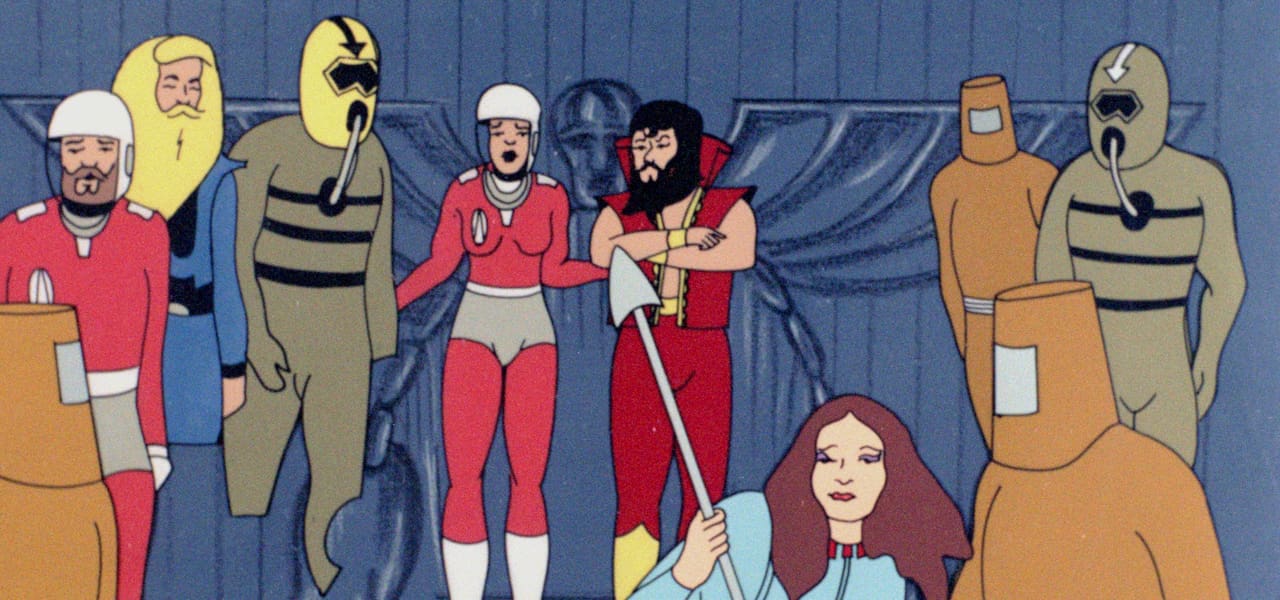
Photo: Deaf Crocodile, via Cartoon Brew
A 64-minute Mexican cartoon that opened in twelve Mexico City cinemas on 3 March 1983, was dropped by ten of them after two days and by the last two the following Wednesday, and was never shown again anywhere, is coming out on Blu-ray this month with a new scan of its negative, Cartoon Brew reported on 16 September. It also carries four and a half minutes of animation painted by hand this year to replace live-action footage that had been lifted from a Japanese film without permission.
Roy del Espacio was only the third animated feature ever made in Mexico, after Los tres Reyes Magos and Los Supersabios, and unlike those two it was not made by professionals but by a titles-and-commercials man, Héctor López Carmona, with a crew that was mostly teenagers, according to the research Cartoon Brew's Jamie Lang drew on for his report.
A film made by teenagers
The producer, Ulises Pérez Aguirre, had the idea, and his own children and their cousins painted cels while still adolescents, one crew member remembered that much of the team came through a high-school job-placement programme, and the only experienced animator on it, Ignacio "Nacho" Rentería, later described recruits tracing frames projected from the 1936 Flash Gordon serial, Lang wrote.
In Lang's description the plot is pulp played straight: radiation from Mars threatens Earth, the United Nations sends the world's greatest astronaut, Roy, on a peace mission with a doctor and a psychologist, and what follows is robots, a despot called King Alom, his hot-blooded daughter, brainwashing, monsters and space battles. Ernesto Cortázar wrote a synthesiser score for it, and Salvador Nájar voiced a hero who, the label notes, never once takes off his helmet, indoors or out.
Production took three years, from 1979 to 1982, and the film's whole life in front of an audience took about a week, after which it never surfaced on television or home video, Lang wrote, and no copy was known to be in circulation. By the 2010s Mexican publications were listing it as lost media, its reputation resting on a handful of promotional pictures and some unkind retrospective accounts, Lang wrote.
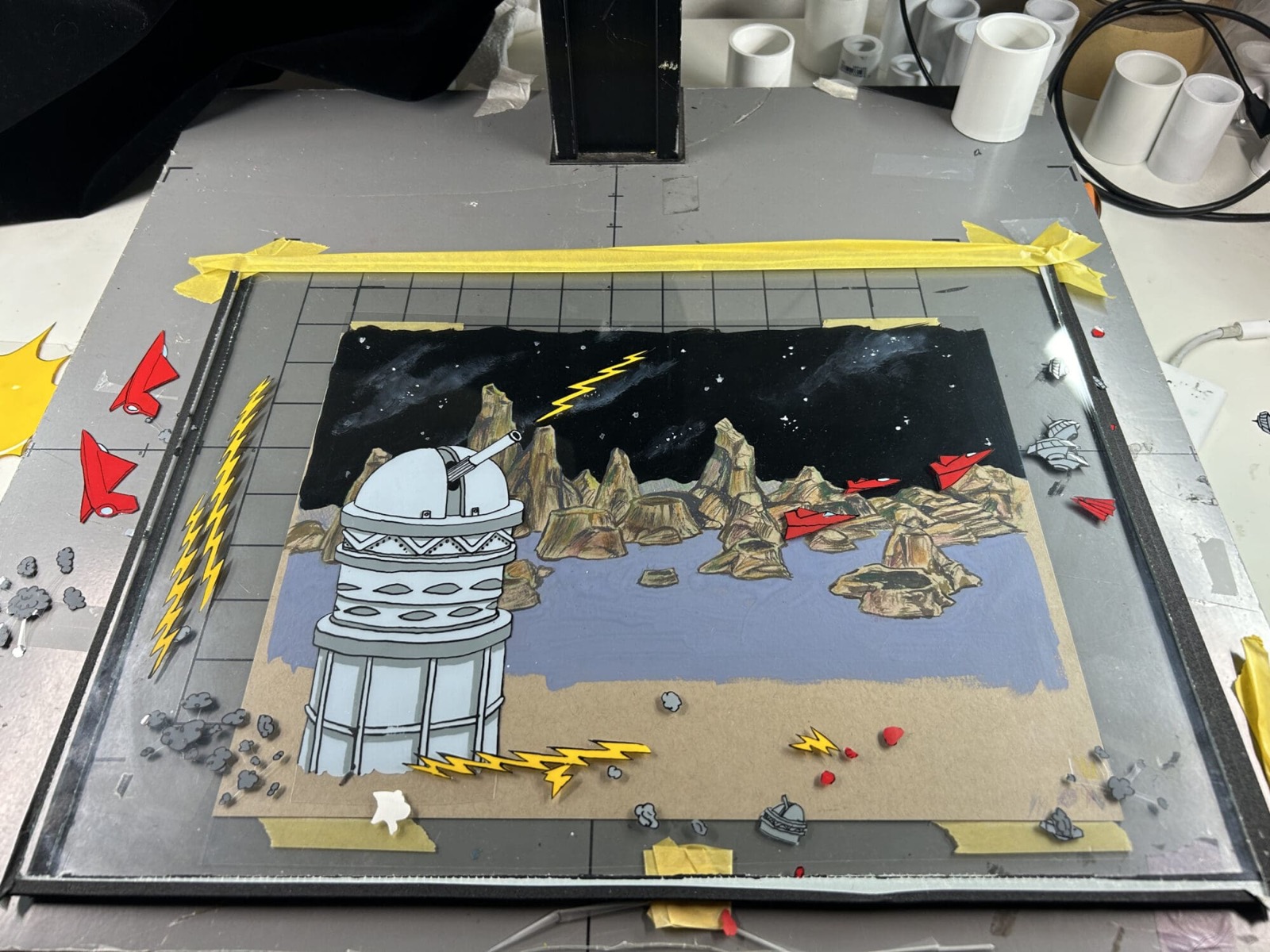
Photo: Isabelle Aspin and Brian Smee, via Cartoon Brew
It was in the vault the whole time
A Colombian researcher, Alejandro Vidal Charris, eventually established that the original 35mm negative had never left the Cineteca Nacional in Mexico City, where it sat in the keeping of the producer's family. The Los Angeles label Deaf Crocodile, working with Pérez Aguirre's daughter Andrea Pérez Mata, secured the rights and paid for a scan before anyone at the company had been able to watch a frame of it, Lang reported.
"No one had seen this since it came out," Isabelle Aspin, one of the two animators later brought in, told Cartoon Brew, and when the scans came back, she said, the reaction at the label was "This is incredible!"
The scan also showed why the film could not be released as found, because among the cartoon sequences were several minutes of live-action spaceships and battles, which earlier researchers working from rumour had guessed came from Battlestar Galactica, and which the label's co-founder Dennis Bartok recognised as footage from Kinji Fukasaku's 1978 film Message from Space, used without permission.
Four and a half minutes
Deaf Crocodile did not have the rights to that footage and could not put it on a disc, and one idea was to replace the missing action with explanatory title cards, the way a silent film would. The label chose instead to commission new animation for those scenes, and a programmer there, Alex McDonald, suggested Aspin and Brian Smee after seeing the handmade look of their music videos.
The two of them were given about a year, and the first plan was to rotoscope the Japanese footage, since so much of the original film had been rotoscoped from Flash Gordon. After a few viewings they saw that the borrowed shots zoomed and panned and flew the camera through space, which López Carmona's camera had never done, so they wrote themselves rules: no zooming, the camera stays still, and nothing moves up or down on the animation stand.
"The goal really was that this should be as seamless as possible and we should be invisible," Smee told Cartoon Brew, and a friend, the animator Patricia Luna, who helped them with the Spanish dialogue and its jokes, suggested treating the stolen footage as a placeholder, an unfinished animatic that they were completing on the original crew's behalf.
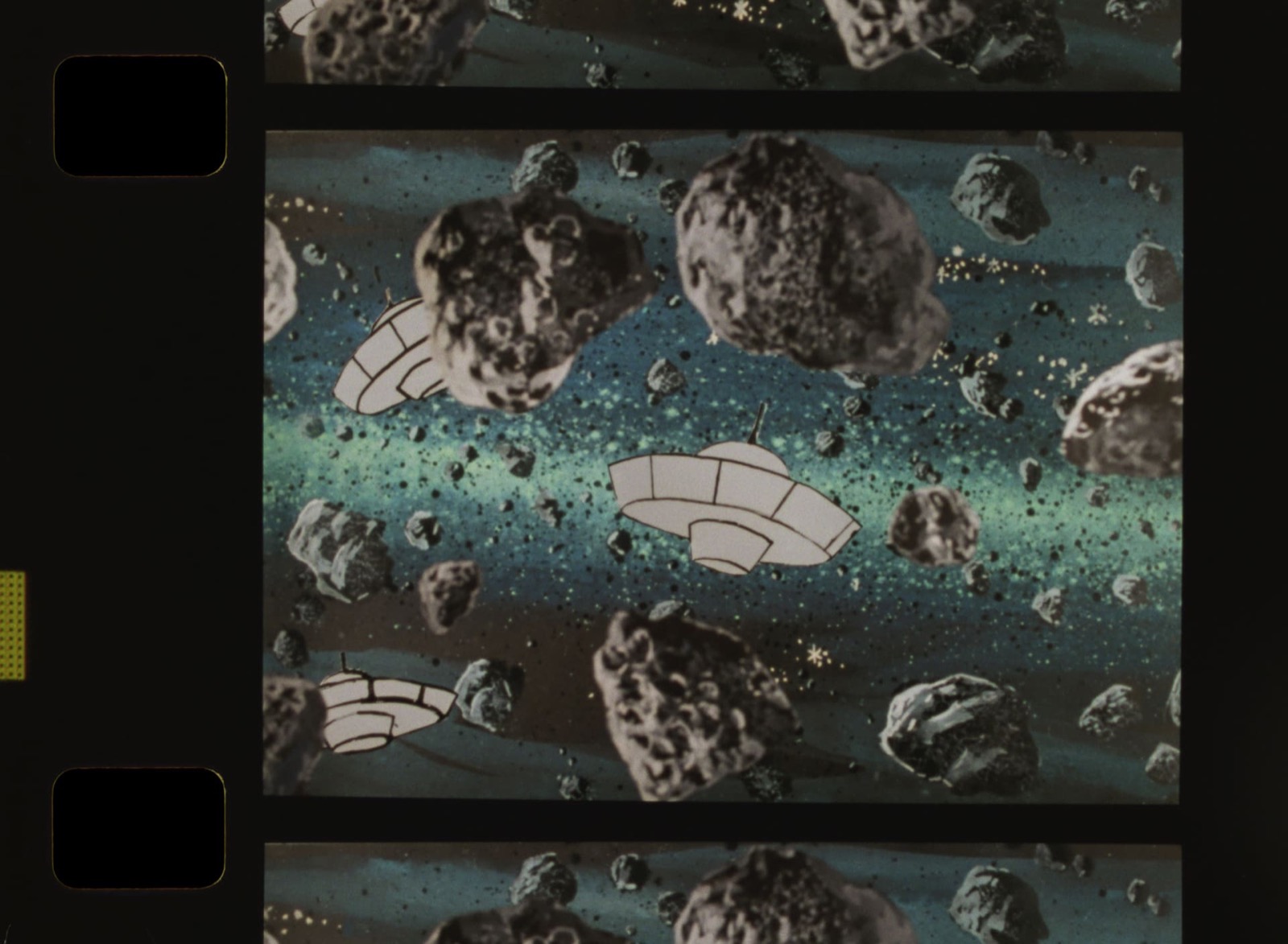
Photo: Isabelle Aspin and Brian Smee, via Cartoon Brew
Paint that stinks
Every background in the new footage was painted on paper, and characters and effects were inked and painted on cels, while the spaceships became a hybrid of cel and cut-out puppetry, outlined on one side of the plastic and painted on the other. They were then trimmed and moved under the camera rather than redrawn for every frame, because, as Smee put it, using a whole sheet of cel for one tiny ship could not be justified.
Cel paint is now a scarce specialist material, and the pair had inherited a stash of old Cartoon Colour and Chroma Colour paint nearly a decade earlier and kept it for the right job, which they used up on these cels, "It really stinks," Smee said. For the one colour they could not find, an opaque yellow, Aspin ended up with Vallejo acrylics made for painting miniature wargaming models, "Thank God for the mini community," she said.
Where a scene needed a place the original artists had never drawn, such as a radioactive dome world, they designed it in the Flash Gordon language the 1982 crew had been copying. Where ships had to fly through a canyon they painted one background and reused it in different crops, since three separate paintings would have been more than the original team would ever have done.
The finished shots were photographed digitally, transferred to 16mm film and scanned back into the restoration with the help of Rob Houllahan and CineLab in Massachusetts, so that the grain of the new material would sit closer to the 35mm footage on either side of it, and Smee said they would have shot it on film outright if there had been time.
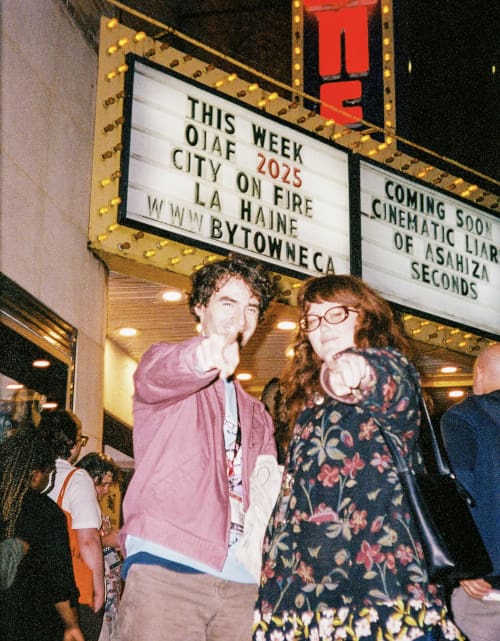
Photo: via Cartoon Brew
The disc
The Blu-ray, listed at $29.95 in a limited slipcover edition on the label's site with 174 copies left at the time of writing, carries the new restoration, a 48-page booklet with essays by Vidal Charris and the critic Walter Chaw, a commentary and a featurette on the new animation. There are interviews with Andrea and Ulises Pérez Mata, their cousin Alejandro Mata and López Carmona's grandson, Héctor Ricardo López Reyes, and the film is in Spanish with English subtitles, according to Deaf Crocodile and to Blu-ray.com.
Aspin's favourite line of villainy in the film translates roughly as "Even if he doesn't die, he won't live." Smee said that what stayed with him was the harshness of the first release, years of work by López Carmona and his family dismissed and locked away after a few days, on a film whose reputation was "one of the worst things ever made" among people who had never been able to see it.
"The whole time, we were just like: this is literally a one-of-one project, and we will never get to do this ever again," Aspin said, and Deaf Crocodile told Cartoon Brew it is working on public and festival screenings of the film beyond the disc.
Carry a story in five words
We run a game called Long Story Short: one real news sentence a day, and you keep the five words that carry it. Today's is below. Do play.
How to play
One real news sentence. The job is to keep the five words that carry the story and let the rest go, then guess. Blue means the right word in the right place, orange means it is one of the five but sitting somewhere else, and grey means it is not one of them. Five tries. The result beats the process, the name or the job beats the place, and little words like a, the and of never count.
Yesterday: John Hanson has now returned an illustrated magazine that was borrowed from Concord Public Library in 1894, soon after a yearlong freeze on overdue fines began. The five: magazine borrowed in 1894 returned.