Christian Bale opens Palmdale village built to keep foster brothers and sisters together
Children taken into care in Los Angeles County are usually separated from their brothers and sisters, because there is rarely a foster home with room for three or four at once. The village that opened in Palmdale on Friday, which Christian Bale began working towards in 2008 after looking at his own daughter and trying to imagine her without parents, was designed from the beginning to take them in together.
15 September 2026
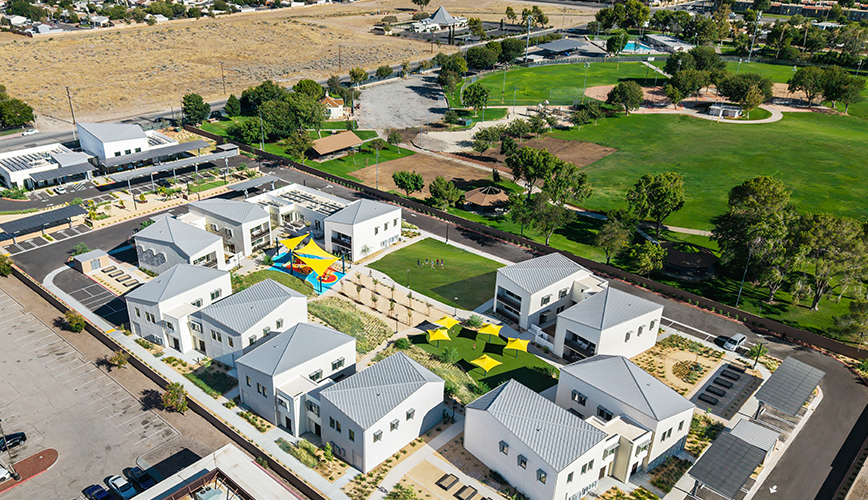
Photo: AC Martin
A village built for children in foster care opened in Palmdale, in the Antelope Valley north of Los Angeles, on Friday afternoon. It consists of twelve townhouses arranged in six duplexes around a shared garden, and it exists for a single reason, which is that brothers and sisters who are taken into care on the same day are very often sent to different houses and do not live together again.
This happens not out of cruelty but out of arithmetic. When social workers remove children from a home they place them wherever a bed is free, and a foster family with room for one child is far more common than a foster family with room for four. By some estimates as many as three quarters of siblings in the American foster system end up living apart from one another, which is a second loss arriving immediately after the first.
"You imagine the trauma of that," Christian Bale told CBS Sunday Morning last year, while the village was still being built. "Added trauma to being taken from your parents, and then you lose your siblings. That's just something that we shouldn't be doing."
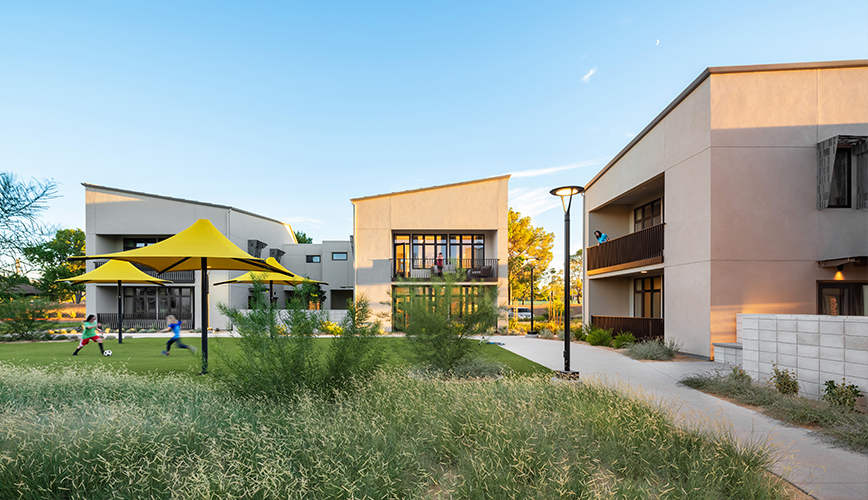
Photo: AC Martin
Eighteen years
Bale has said that the idea came to him around 2008, when he looked at his young daughter and tried to imagine what would happen to her if she had no parents. He began reading about the foster system, and having read about it he went looking for somebody who knew it from the inside, which is how he found Tim McCormick, who had spent decades running foster homes in Chicago. Bale asked him to come and help, and together with his wife Sibi and his friend Dr Eric Esrailian he set up a charity to build something that did not yet exist anywhere in California.
It then took sixteen years to get as far as breaking ground, which he finally did in February 2024, in a week of storms that cleared on the morning of the ceremony. The project cost roughly $22 million. The city of Palmdale contributed $1.2 million, the Austrian American Council West raised close to $9 million, and the Los Angeles County Development Authority approved a $3 million loan on 1 September this year, ten days before the doors opened.
What has been built
The twelve houses sit on four and a half acres facing inwards, so that the front doors open onto the garden rather than onto a road, and they were drawn deliberately large so that a group of four or five children arriving together can actually be accommodated together rather than in theory. Full-time foster parents employed by the charity live in the houses with the children.
There are also two studio flats set aside for young adults leaving the system at eighteen, an age at which support in most American states stops abruptly. A community building of 7,000 square feet contains a multi-purpose room, a learning lab, a kitchen and desks for the case managers who look after each child's paperwork, schooling and medical care. Solar panels have been mounted over the car park, where they generate electricity and shade the cars.
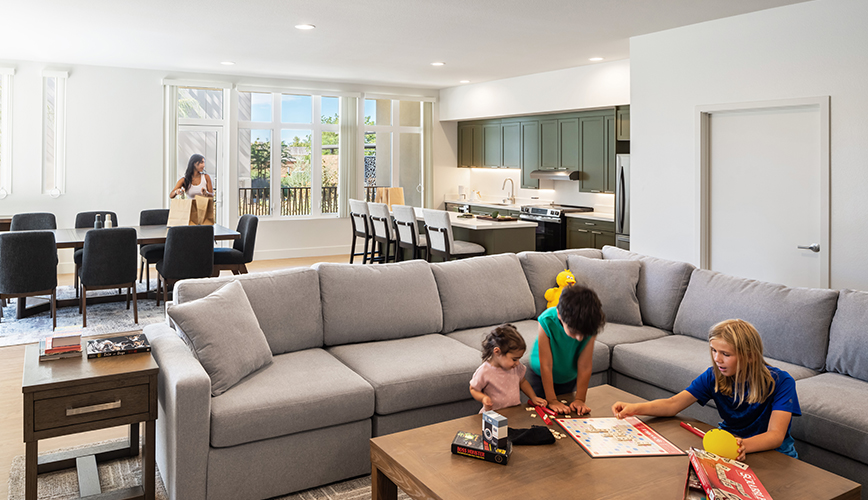
Photo: AC Martin
Los Angeles County has more children in foster care than any other county in the United States, somewhere above thirty thousand at any one time, and a village of twelve houses is not going to alter that figure in any measurable way. What it does is give a small number of families somewhere to arrive intact.
Friday
Bale came to the ribbon-cutting with Sibi. Kathryn Barger, the county supervisor whose district covers the Antelope Valley and who has backed the scheme since she first heard about it, was there, and so was Veronika Reinelt of the Austrian American Council West, whose fundraising paid for a large part of it. Somebody had brought a bag of footballs.
"It's our job to turn their heartbreak and their pain into love and hope and a sense of future," Bale said.
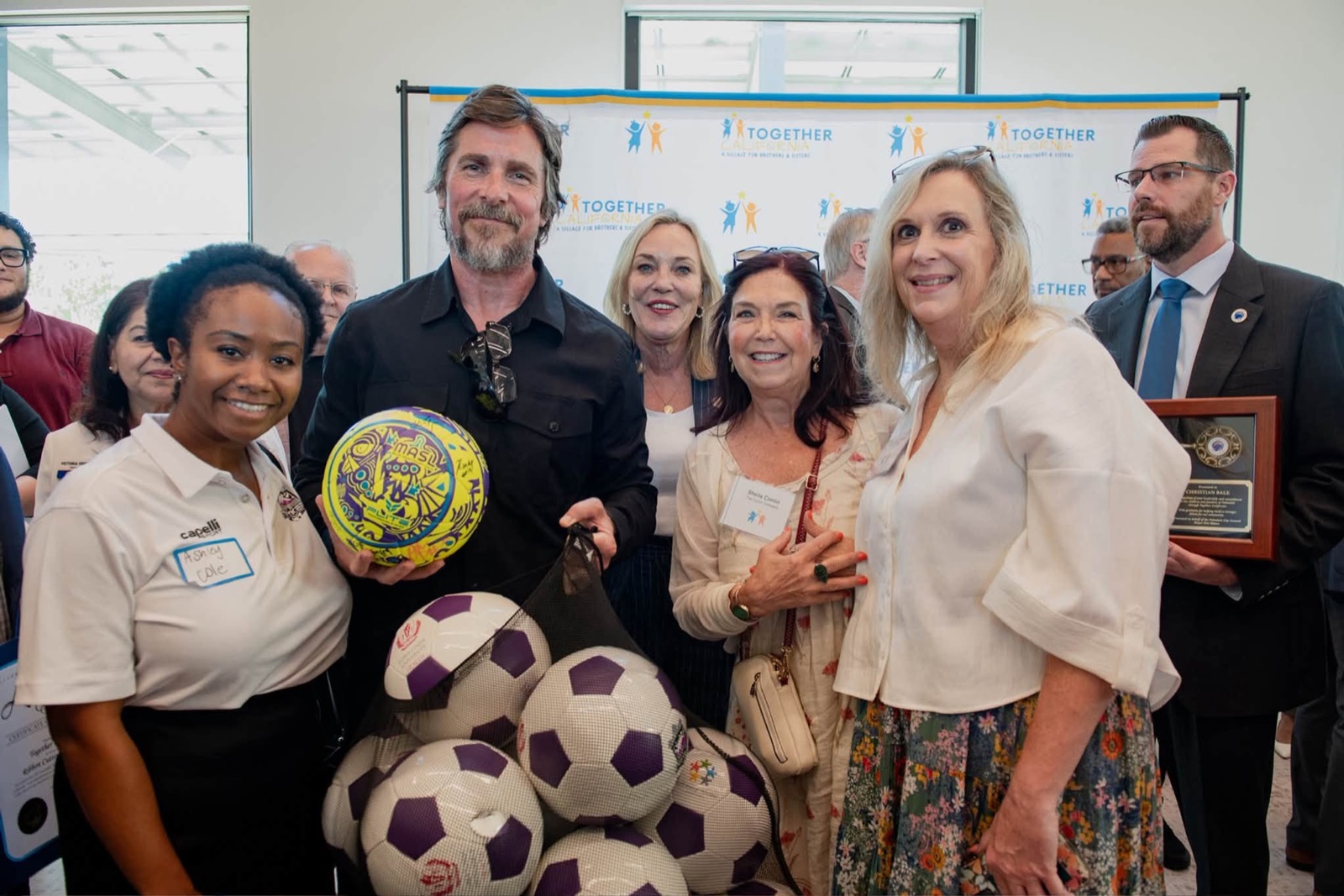
Photo: Supervisor Kathryn Barger's office, via Antelope Valley News
He was asked once what it takes to get involved in something like this if you have no connection to the care system yourself, and said that he does not think it takes very much at all. "It just requires having a heart."
Perhaps the greatest legacy we can leave is not that our names will be remembered, but that children's lives are better because we cared.Veronika Reinelt, Austrian American Council West
Carry a story in five words
We run a game called Long Story Short: one real news sentence a day, and you keep the five words that carry it. Today's is below. Do play.
How to play
One real news sentence. Tap the five words a headline would keep, in whatever order the headline reads, then guess. Blue means right word, right spot. Orange means it is in the headline, somewhere else. Grey means it is not in it. Five tries. The result beats the process, the name or the job beats the place, and little words like a, the and of never count.
Yesterday: Tommy Price was on a 66-mile run in 2022 when a cardiac-arrest dropped him face down in the snow with no pulse, and four years later the survivor finished the same route. The five: cardiac-arrest survivor finished 66-mile run.