Strangers on a 36-hour train home to Xinjiang took turns babysitting a young couple's quintuplets
Abu and Dili's quintuplets were born in Wuhan in February, 3,500 km from their home in Xinjiang. In October they finally took the five babies home by train. For 36 hours, the crew and the people in the berths around them fed, held and rocked the babies so the parents could sleep.
20 October 2026
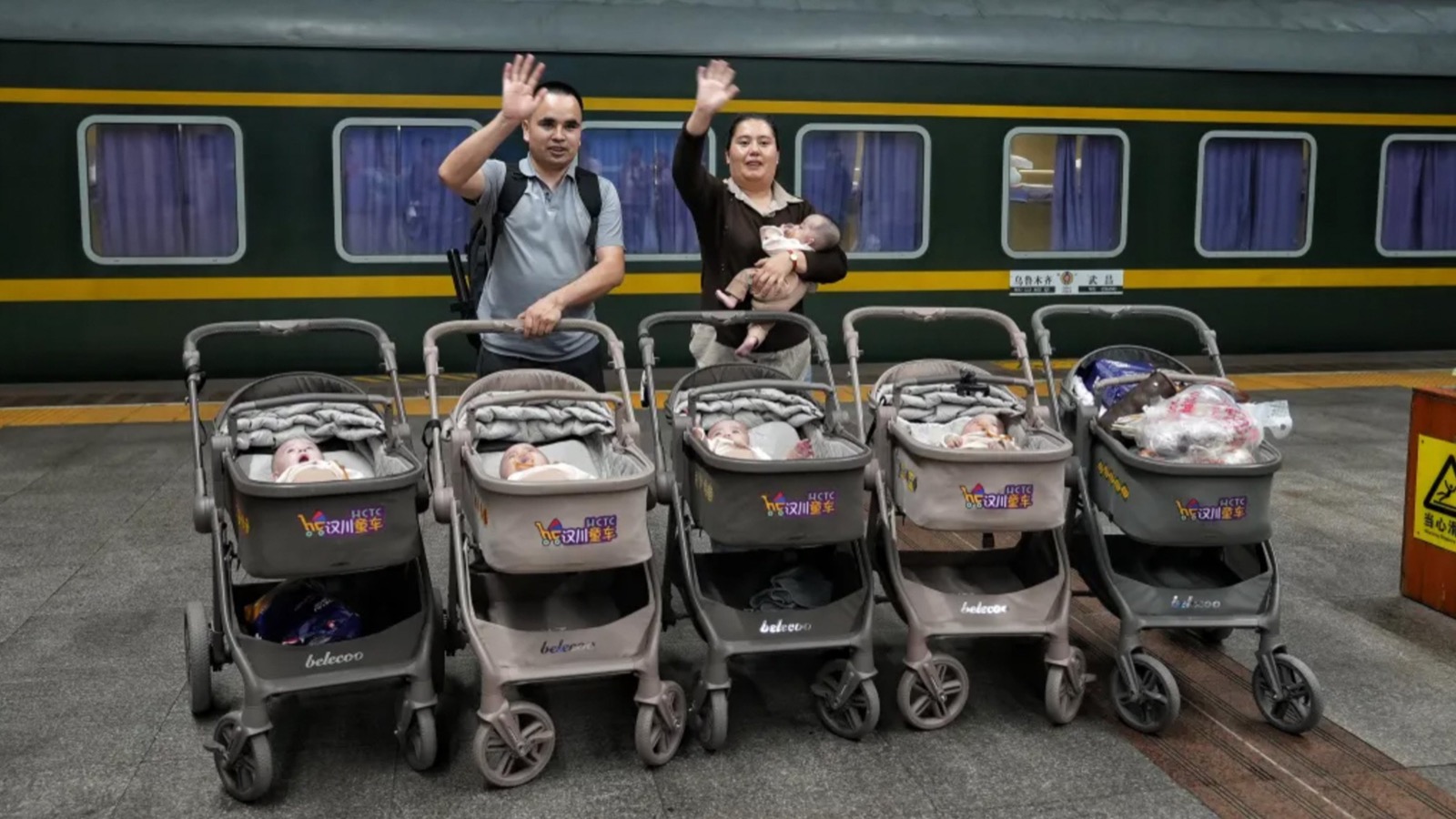
Photo: via South China Morning Post
A young couple from Xinjiang, in north-west China, took their seven-month-old quintuplets home on a 36-hour train ride, and the passengers around them helped raise the babies for the whole trip, the South China Morning Post reported on Saturday, citing Hubei Daily.
Five at once
The father, known as Abu, and the mother, Dili, both 24, come from Hotan, in the south-west of Xinjiang.
Dili had been diagnosed with polycystic ovary syndrome, which can make it hard to get pregnant. She conceived naturally anyway, Hubei Daily reported, and on 26 February she gave birth to one boy and four girls at a major hospital in Wuhan.
For seven months the parents and Abu’s sister looked after the babies in Wuhan, about 3,500 km from home.
9 October
On the evening of 9 October the family boarded the train home. They had five strollers, bottles of formula, nappies and bags of clothes, and railway staff helped carry it all on.
A member of staff moved them from a middle berth to a lower one, so there was room to lay the babies down and reach them.
Then the crew and the passengers nearby started taking turns. They fed the babies, held them and rocked them to sleep, so that Abu, Dili and his sister could rest.
Word spread down the train. Videos shared online showed passengers queuing at the family’s berth to see the babies, take pictures and feed them.
I can’t move. I’m nervous that I’ll wake her up.A young woman holding one of the sleeping babies
“I saw them in a news report,” a man said in one video. “I’m so lucky to meet them on the same train. I have to seize this chance to see the five babies, who all look exactly alike.”
The upper berth
A passenger named Zhao had the berth above the family. She barely slept that night. Every time she heard a baby cry, she climbed down to help.
When Abu and Dili kept thanking her, she told them helping was simply what people do.
When we’re away from home, helping each other is what we should do.Zhao, the passenger in the upper berth
Abu said he took the night shift, feeding the babies every four hours, while his wife and sister took over in the day. “I catch up on sleep after dawn,” he said.
11 October
On the morning of 11 October the family got off at Urumqi, the capital of Xinjiang, after 36 hours on the train.
From there they planned another train to Hotan, where they will hold the babies’ 100-day banquet, a traditional party wishing newborns health and a long life. They had put it off because the journey home was so long.
Carry a story in five words
We run a game called Long Story Short: one real news sentence a day, and you keep the five words that carry it. Today’s is below. Do play.
How to play
One real news sentence. The job is to keep the five words that carry the story and let the rest go, then guess. Blue means the right word in the right place, orange the right word in the wrong place.
Yesterday: After an Irishman’s wedding ring slipped off in a mountain stream, Italians he had never met spent days in the rapids, then went to Ireland to return it. The five were Italians return Irishman’s wedding ring.