The Data Dropthe question in the corner of the mapby Akash Wadhwani29 August 2026sources: Google
The question in the corner of the map
Google Maps asks you things. Was it busy. Do they do takeaway. Is there a step at the door.
That last one is there because a bloke who works on Google Drive spent a year of Fridays on it.
Bar Soho
Bar · Open until 23:00
23–25 Old Compton Street
Opens 12:00
Wheelchair accessible entrance
Does this place have a wheelchair accessible entrance?
1answer, yours
01
A bar on Google Maps. Address, hours, photos, reviews, price range, how rammed it gets at 7pm on a Thursday.
For years that was the whole card. It could tell you the wine was overpriced and the toilets were grim. It could not tell you whether you could get through the door.
Which, if you use a wheelchair, is the only line that decides anything.
02
Rio Akasaka is a product manager at Google. He works on Drive. Not Maps. Drive.
Google lets you spend about a fifth of your week on something that isn't your job. In 2016 he spent his on this, and kept spending it for about a year, with five to ten other people chipping in around their own work.
They didn't build a map layer, or a database, or a partnership with a disability charity.
They built a question.
03
It turns up when you're near somewhere you've already been. One tap and you're done.
Go on then. It's on the card. No wrong answer, nobody checks your work, and nothing else here moves until you press something.
That's the whole design. Yes, no, or a shrug, from whoever happens to be standing outside at the time.
The rule is written down: about three feet wide, no steps, or a ramp if there are. A revolving door on its own counts as a no.
No form. No account. No training. It went out first in London, New York, Tokyo, Mexico City, Boston and Sydney.
04
That's it. That's the whole job.
Google counts 120 million Local Guides, the people who answer questions about places they've been, and over 500 million answers about this specifically.
Once enough of them agree, the line shows up on the card with the little symbol next to it.
And the next person doesn't have to guess.
Enjoyed pressing that button? We make a daily word game. Cut a sentence down to five of its own words.
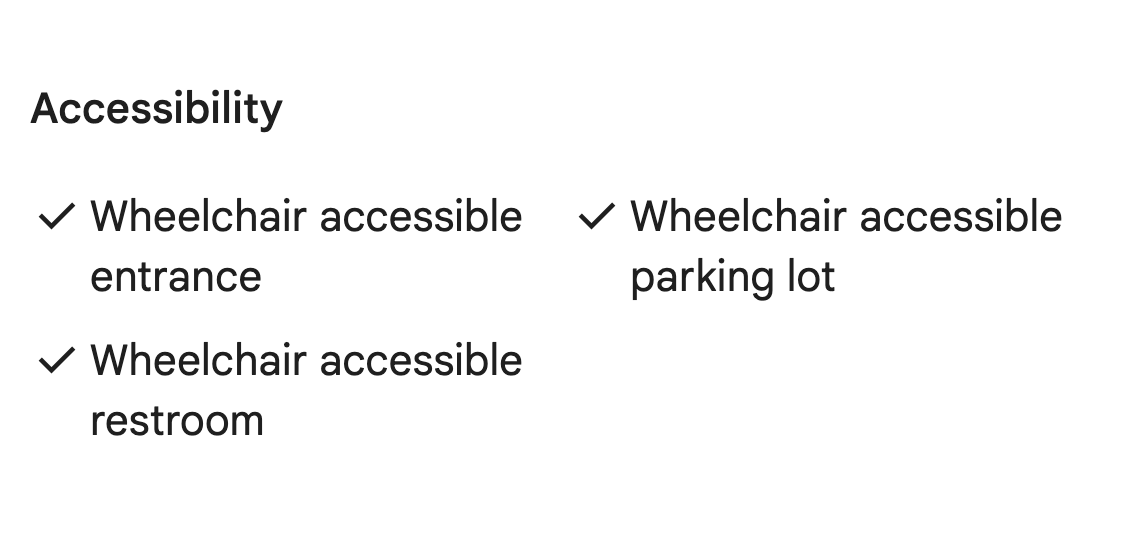
That card was mine, so you could have a go. This one isn't. It's the British Museum on Google Maps this morning, under About. Three lines, put there by people who turned up and looked.
Google Maps · The British Museum · About tab · screenshot taken 29 August 2026
120m
Local Guides answering questions about the places they visit
500m
accessibility answers they have contributed to Maps
200
meet-ups held around the world, purely to sit and fill this in
Then there's Sasha
Sasha Blair-Goldensohn worked on Google Maps. On 29 July 2009 he was walking through Central Park to the office and a rotten branch came down on him. He was 33. He woke up a month later, and he has used a wheelchair since.
“I was going to use a wheelchair for the rest of my life, and my experience as a born and bred New Yorker was about to change forever.”
Sasha Blair-Goldensohn, writing on Google's own blog
He went back to work in 2011 and found his own product didn't work for him.
“This thing that I'd been working on forever, Google Maps, what so many people use to get around, it didn't work for me. If I wanted to go to meet up at a cafe, I could find out the hours, beautiful pictures of the food, I couldn't find out if I could get in the door.”
Sasha Blair-Goldensohn, Here & Now, June 2025
So he joined Akasaka's lot. He is now Google Maps' disability inclusion lead. The person who wrote the question and the person who needed it answered ended up on the same team.
Places on Google Maps carrying accessibility information
google's own published figures
Fifteen million places when Google first put a number on it in 2020. Fifty million now. All of it typed in by people who were standing there anyway.
Two hundred meet-ups
This is the bit I keep thinking about. Local Guides held about two hundred meet-ups whose entire purpose was sitting in a room together answering these questions. Between them they did twelve million places.
Google names two of them: Emeka in Nigeria and Ilankovan in Sri Lanka. Both ended up as accessibility ambassadors, which I assume comes with a lanyard.
About 65 million people use a wheelchair. None of them will ever know who answered for which door, which is sort of the point.
New York subway stations with step-free access
92 of 425 in 2017 · a court settlement now requires 95% by 2055
Blair-Goldensohn did not stop at the icon. He joined a lawsuit brought by Disability Rights Advocates against the Metropolitan Transportation Authority. In 2023 a judge approved the settlement. A second case, about keeping the lifts working once they are installed, is still going.
Long Story Short. One sentence, five words, five tries, once a day.
mta elevator and escalator asset inventory · 478 lifts, 420 with an install date
Thirty years of not very much. Then the settlement Sasha helped win landed in 2023, and 2024 was the biggest year the subway has ever had for lifts.
Share of station complexes with step-free access
2017 from his New York Times piece · 2026 from MTA open data · 2055 from the settlement
92 of 425 when Sasha wrote about it in 2017. 124 of 445 now. Eight years of lawyers and drilling moved it six points. The settlement says 95% by 2055, so check back in twenty-nine years.
Berlin did it first
None of this was Google's idea. Raúl Krauthausen had it six years earlier.
He was born in Lima in 1980, grew up in Berlin, has brittle bone disease and has used a wheelchair his whole life. In 2004 he and his cousin Jan Mörsch started a nonprofit called Sozialhelden, which means social heroes. In 2010 they put out a map called Wheelmap. Green if you can get in, amber if there's a small step, red if you can't.
Same idea, one tap, no company behind it, half a decade early.
Nobody ran this as a campaign. It's a Drive PM's side project and a lot of people tapping Yes outside a café.
People also ask
Where do these numbers come from?
All of them are Google's own published figures, mostly from the blog posts "Find wheelchair accessible places with Google Maps" and "How I'm making Maps better for wheelchair users like me", plus later press coverage. 15 million places in May 2020, more than 40 million by 2023, 50 million at the most recent count, 120 million Local Guides, 500 million accessibility contributions, around 200 meet-ups covering 12 million places, and 65 million wheelchair users worldwide. They are self-reported and nobody outside Google can audit them, which is worth holding in mind.
Who is Rio Akasaka?
A product manager at Google whose main job is Google Drive. Press coverage of the 2016 launch describes the wheelchair accessibility work as his 20% time project, built with between five and ten other Google employees over about a year, and credits him as the person behind it. It first went out in London, New York, Tokyo, Mexico City, Boston and Sydney.
Is the story about the tree branch true?
Yes, and it is documented well beyond the interview. Contemporaneous court reporting puts it on 29 July 2009 near West Drive and West 63rd Street in Central Park, with a branch estimated at 100 pounds. His wife Rebecca Min sued the City of New York for $120 million and the case settled for $11.5 million in 2012. Blair-Goldensohn has written about it himself on Google's blog and in the New York Times, and his role at Google is public.
Is the question on the card real?
The card near the top of this page is a mock-up, drawn to look like Maps so you could try the interaction yourself. The real prompt appears inside the Google Maps app when you are near a place you have visited, and the wording varies. The screenshot of the British Museum's Accessibility section is genuine, taken on 29 August 2026.
Why is there no map on this page?
Because Google's accessibility data cannot be shown. Its Places API returns a single true or false flag with no author and no date, there is no way to query a whole area at once, and the terms do not allow storing the results. A map built from it would have no people in it, and the people are the story.
Is this page connected to Google?
No. It is made independently from public statements and press coverage, and it is not affiliated with or endorsed by Google. The wheelchair symbol is the International Symbol of Access, designed for Rehabilitation International in 1968, and is in the public domain.
Right, that is the story. Now go and play the game.