We know exactly what they look like.
Identical units roll off one production line by the thousand, so there is no portrait of any single one. What changes is the generation. Step through them.
SpaceX
Identical units roll off one production line by the thousand, so there is no portrait of any single one. What changes is the generation. Step through them.
From your dish, 550 km straight up to a satellite passing overhead, across the sky by laser, down to a gateway wired into the internet, and back. The whole round trip takes about 25 to 60 milliseconds. Low enough for a video call.
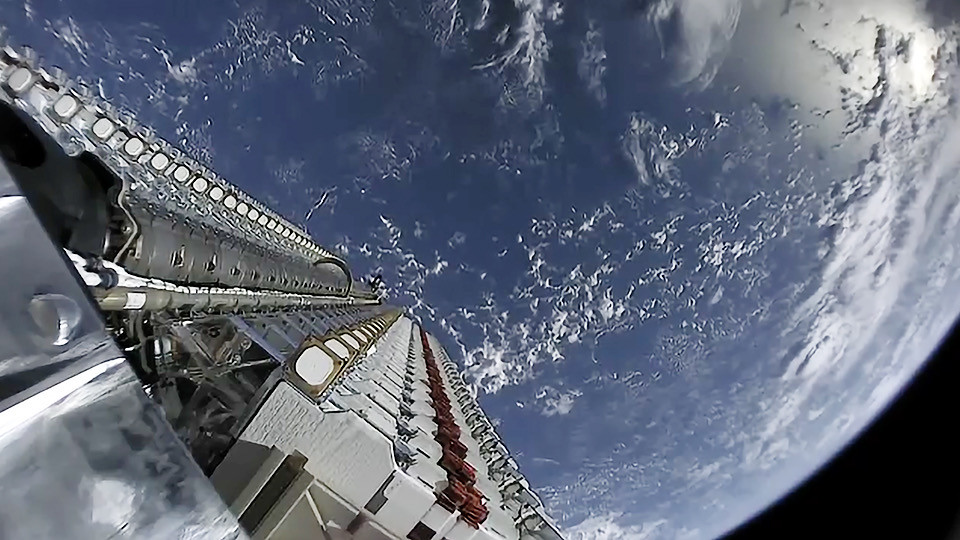
Each Falcon 9 carries a stack of Starlinks to orbit, then flies its booster back to Earth to do it again.
Which is how a few dozen satellites in 2019 became more than ten thousand.
The first 60 launched in May 2019. By mid-2026, about 10,400 were in orbit. Starlink alone is now roughly 65% of every active satellite humanity has in space. Hover the curve.
Reusing the booster is what makes ten thousand satellites affordable. Some have flown more than twenty times.
A dish, a clear view of the sky, and you are online in minutes. First responders, ships, field camps, and storm-hit towns run on it.
A fast connection in places fibre was never going to reach. Oceans, mountains, islands, war zones, and aeroplanes at 38,000 feet.
One interactive story like this, in your inbox each week. Free, no spam, on whatever the world is talking about.
An independent data visualization by sheets.works. Not affiliated with, endorsed by, or connected to SpaceX or Starlink. Orbital data from CelesTrak (GP data, CSV), originally tracked by the US Space Force, propagated in your browser with SGP4.
You’ve seen the whole constellation. Drop your email to read the rest. One drop like this a week, free.